
Finding a single cow on a large pasture is a daily drain on labor. Ranchers spend hours on horseback or in vehicles just to confirm animals are where they should be. A sick cow can go unnoticed for days, and heat detection still relies heavily on visual observation. A livestock GPS ear tag tracking system changes this by putting real-time location, activity, and health data directly onto a rancher’s phone or computer — cutting the time needed for routine herd checks from hours to seconds.
But how does this technology actually work? What is the difference between GPS, RFID, and BLE ear tags? And what kind of return can a farm expect from investing in herd tracking? This guide explains the components, the research behind the technology, and how to evaluate whether a monitoring system fits your operation.
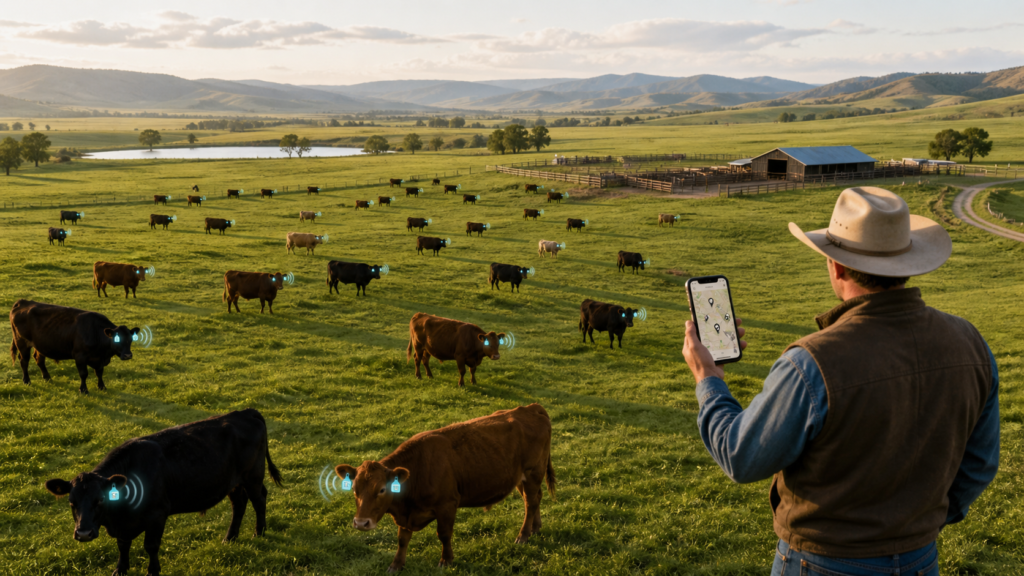
What Is a Livestock GPS Ear Tag Tracking System
A livestock GPS ear tag tracking system is a digital herd management tool that uses lightweight ear tags worn by each animal to collect and transmit real-time data — location, movement, and body temperature — to a cloud platform accessible from any internet-connected device.
The system has three core components, as described in research published in Sensors (2020): GPS-based livestock tracking systems enable real-time monitoring of animal location and movement, improving herd management efficiency and reducing time spent locating animals (Aquilani et al., 2020).
The Ear Tag — Data Collection at the Animal
Each animal wears a small, lightweight tag (typically 14 grams or less) attached with a standard ear tag applicator — the same tool used for visual ID tags. Inside the tag, a suite of sensors works continuously: a 3D accelerometer tracks movement and activity levels, a precision thermistor measures body temperature to within 0.1°C, and a Bluetooth Low Energy (BLE) transmitter sends data to the nearest gateway every 20 minutes. Battery life extends to three years under normal conditions, so animals are tagged once and monitored for multiple seasons.
The Gateway — Data Relay Across the Property
Gateways are the bridge between the ear tags and the cloud. Placed strategically around the property — on barn walls, fence posts, or hilltop poles — each gateway receives signals from up to 1,000 ear tags within a 200-meter radius. The gateway converts the BLE signal to 4G cellular data and uploads all information to the cloud. Gateways are IP65 weatherproof, operate from -40°C to +70°C, and use dual power (mains plus battery backup) so data keeps flowing through power outages. Each gateway includes its own GPS chip so the system knows where every data point originates.
The Cloud Platform — Insights on Any Device
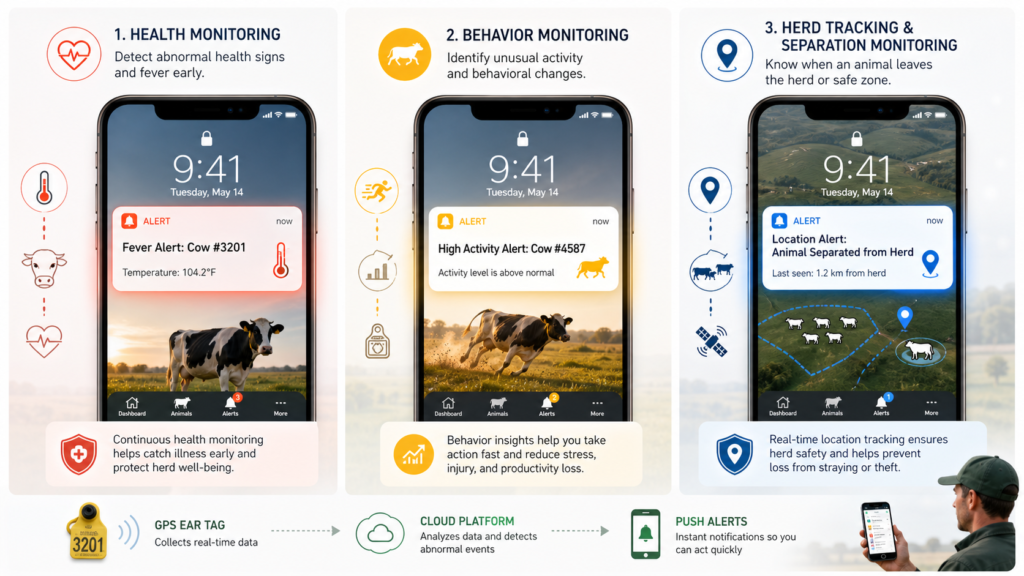
The cloud platform is where raw data becomes actionable information. The rancher opens a mobile app or web dashboard to see a map of all tagged animals, run an automatic headcount that completes in seconds, review individual animal temperature and activity trends over the past seven days, and receive instant alerts when the system detects anomalies — a cow spiking a fever, an animal separated from the herd, or a female showing the activity surge that signals estrus.
Studies published in the Italian Journal of Animal Science (2025) confirm that GPS devices attached to livestock (including ear tags or collars) allow continuous monitoring of behavior, grazing patterns, and spatial use in cattle systems (Mancuso et al., 2025).
Why Livestock GPS Tracking Changes How Ranches Operate
The most immediate benefit of a tracking system is time. Instead of physically checking every paddock, a rancher opens an app and confirms the entire herd’s location in seconds. On large extensive grazing operations — common in Australia, Argentina, the western United States, and Brazil — this alone can save several hours of labor daily.
But the system’s value extends well beyond location tracking. Continuous temperature monitoring catches illness early. A fever spike of just 1–2°C above an animal’s baseline triggers an alert, often 24–48 hours before the animal shows visible signs of sickness. For feedlot operators managing respiratory disease risk, or dairy managers watching for early metritis in fresh cows, this early warning means earlier treatment and better outcomes.
Activity-based heat detection is another significant labor-saving function. Cows in estrus show a characteristic spike in daily movement — often doubling or tripling their normal step count. The platform detects this deviation from the individual animal’s seven-day rolling average and sends a heat alert. Ranchers can time AI breeding precisely without relying on visual observation or expensive synchronization protocols.
How a GPS Ear Tag System Detects Health and Heat Events
The detection logic is straightforward but powerful. Each animal serves as its own baseline.
Fever Detection
Every ear tag reports temperature every 20 minutes. The platform builds a normal range for each animal based on its own historical data. When a cow’s temperature rises more than 1.5°C above her individual average, the system triggers a health alert. Because temperature changes often precede visible symptoms, this gives ranchers a critical 24–48 hour head start on treatment. The same logic applies to detecting hypothermia or sudden temperature drops in cold weather.
Heat (Estrus) Detection
Activity data drives heat detection. The 3D accelerometer in each tag records movement continuously. When a cow enters estrus, her activity level spikes sharply — often two to three times her normal daily movement. The platform compares the spike to her own seven-day average and, if the deviation exceeds a preset threshold, sends a heat alert. This allows the rancher to breed on time without visual heat detection or synchronization.
Lameness and Illness Indicators
A sudden drop in activity can be as informative as a spike. An animal that normally moves actively through the paddock but suddenly becomes lethargic may be developing lameness, acidosis, or another systemic issue. The platform flags these deviations so the rancher can investigate.
Common Questions
GPS ear tags use satellite positioning to provide precise coordinates anywhere — ideal for very large, open rangeland — but consume more power and require more frequent recharging. RFID ear tags use radio frequency identification; an animal is recorded when it passes near a reader, typically at a gate, chute, or water point. BLE (Bluetooth Low Energy) ear tags transmit data to a nearby gateway approximately every 20 minutes, providing zone-level location based on gateway proximity while maintaining a battery life of three years or more. Most modern livestock systems use BLE for the optimal balance of data frequency, battery life, and cost.
Most BLE-based systems provide zone-level accuracy — the platform tells you which gateway the animal is nearest to, typically within a 200-meter radius. This approach extends tag battery life compared to satellite GPS tags. For a cow in a 50-hectare paddock, zone-level location is sufficient for a rancher to drive or ride to the right area and visually locate the animal within minutes.
The gateway requires a 4G cellular signal to upload tag data to the cloud. If your property has poor or no signal, a high-gain external antenna can often boost reception enough to connect. In extreme cases, placing the gateway on a hilltop or on the highest barn roof can capture a reliable signal even when ground-level coverage is weak. A site signal survey during the planning phase identifies the best gateway locations.
Typical BLE ear tags carry a 3-year battery and are sealed, non-rechargeable units. When the battery expires, the tag is replaced with a new one using a standard ear tag applicator. The 14-gram weight and standard application method mean no specialized training or equipment is needed to tag or re-tag an animal.