
Milking efficiency is the single biggest factor that separates profitable dairies from marginal ones. A farm milking 200 cows twice daily spends roughly 1,500 hours per year with units on cows. Shaving even a fraction of that time through better parlor design frees up hundreds of hours annually — time that can go toward herd health, feeding management, or simply reducing labor costs. The parallel milking parlor has become one of the most widely adopted designs in modern dairy farming because it solves this efficiency equation directly: more cows milked per hour, in a smaller building footprint, with fewer operators.
But how does a parallel parlor actually work? What makes it different from a herringbone or rotary setup? And how do you know if it is the right fit for your herd size and barn layout? This guide answers those questions with practical comparisons, research-backed data, and a clear decision framework.
What Is a Parallel Milking Parlor
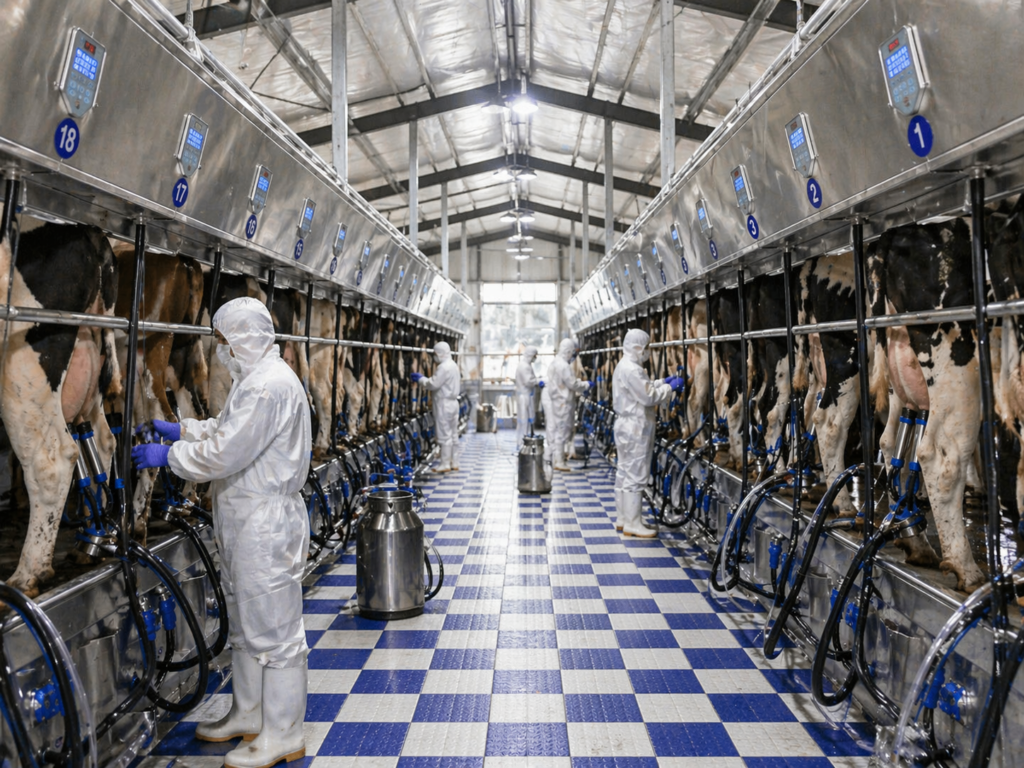
A parallel milking parlor is a dairy milking system where cows stand side by side, perpendicular to a central operator pit. This arrangement — often called a side-by-side parlor — places the milker behind each cow, working between her hind legs to attach the milking unit. The defining advantage is density: more milking units fit into a shorter building length than any other parlor design.
In a parallel configuration, cows enter as a group, line up in individual stalls, and are milked simultaneously. Once the entire row is finished, the front gate opens and all cows exit together. This batch-style operation contrasts with rotary parlors, where cows load and unload continuously, or herringbone parlors, where cows stand at an angle rather than perpendicular.
According to FAO dairy processing guidelines, mechanized milking systems are developed to increase efficiency, reduce labor, and improve hygiene standards in milk production systems (Source: FAO, 1998, Milk Processing Guide Series, Vol. 6).
Why Parallel Milking Systems Have Become the Standard for Modern Dairies
The shift from stanchion barns and bucket milkers to parallel parlors represents one of the biggest productivity leaps in dairy history. Three factors drive this preference.
First, labor efficiency. In a well-designed parallel parlor, a single operator can manage 12–20 milking units per side. With two operators in a double-12 configuration, a farm can milk 24 cows at a time — completing a 200-cow herd in roughly 90 minutes. In contrast, the same herd milked in a stanchion barn with pipeline units typically takes significantly longer and requires more labor. Parallel milking parlors are specifically designed to increase throughput by allowing multiple animals to be milked simultaneously in a structured layout, improving operational efficiency in large-scale dairy farms (Source: Bickert et al., 2000, Dairy Freestall Housing and Equipment, MWPS-7).
Second, space utilization. A parallel parlor fits more stalls into a shorter building because cows stand perpendicular to the pit. For farms with limited barn width or those retrofitting an existing structure, this space-saving design can be the deciding factor.
Third, cow comfort and consistency. The side-by-side layout minimizes individual cow handling time. Cows enter and exit as a group, reducing the stress of isolation. The operator works at udder height in a lowered pit, which is both ergonomic and efficient. Consistent milking routines — same sequence, same duration, same pulsation settings — improve milk let-down and reduce mastitis risk over time.
How a Parallel Milking Parlor Works
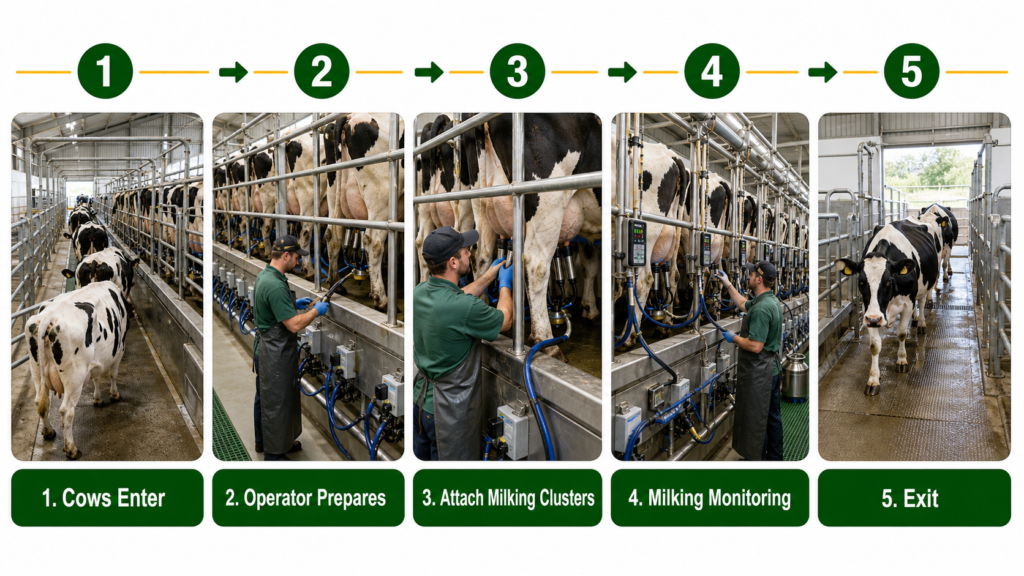
The parallel milking process follows a structured batch rhythm. Understanding each stage helps clarify why throughput is so much higher than in traditional systems.
Step 1 — Cow Entry and Positioning
Cows enter the parlor platform as a group, guided by a crowd gate. Each cow steps into an individual stall and faces the opposite wall, standing perpendicular to the operator pit. A front gate closes to secure them in position.
Step 2 — Operator Access and Preparation
The operator stands in the lowered central pit, which places the udder at approximately chest height. This ergonomic positioning reduces bending and reaching. Each cow’s teats are cleaned (pre-dipped), fore-stripped to check for abnormalities, and dried before unit attachment.
Step 3 — Milking Unit Attachment
Because cows stand side by side and face away, the operator accesses the udder from behind, between the hind legs. This rear-access approach is unique to parallel parlors and requires a slightly different technique than the side-access approach used in herringbone systems.
Step 4 — Milk Harvest and Monitoring
Milk flows through individual transparent meters at each stall, allowing the operator to visually inspect for abnormalities — early signs of mastitis. Electronic pulsators control the vacuum and massage phases, mimicking a calf’s natural nursing rhythm to stimulate complete milk let-down.
Step 5 — Unit Removal and Cow Exit
When flow drops below a preset threshold, automatic cluster removers (if equipped) detach the milking units. The front gate opens and all cows exit the platform simultaneously, walking forward into the return alley. The platform is quickly rinsed, and the next batch enters.
Parallel vs Herringbone vs Rotary: Which Milking Parlor Design Fits Your Farm
Choosing a milking parlor design is a decision that shapes daily operations for a decade or more. The right choice depends on herd size, labor availability, barn footprint, and budget. Here is how the three main designs compare.
| Feature | Parallel (Side-by-Side) | Herringbone (Fishbone) | Rotary (Carousel) |
|---|---|---|---|
| Cow Position | Perpendicular to pit | Angled (30–45°) to pit | On a rotating platform |
| Operator Access | Rear access, between hind legs | Side access to udder | Rear access from fixed position |
| Space Efficiency | Most stalls per meter of building | Requires longer building | Large circular footprint |
| Throughput | High — batch-style, fast flow | Moderate to High | Highest — continuous flow |
| Capital Cost | Moderate | Moderate | Very high |
| Labor Requirement | Low — 1–2 operators | Low to Moderate | Very low — highly automated |
| Best For | Medium to large herds (100–2,000+ cows) | Herds of 50–500 cows | Large operations (1,500+ cows) milking 24/7 |
| Maintenance | Low — standard components | Low | High — complex rotating platform |
Table 1: Comparison of the three main dairy parlor designs
When a parallel parlor makes sense. If you are milking more than 100 cows, have limited barn length, and want to maximize throughput per operator, a parallel parlor is typically the most cost-effective choice. It scales well — starting at a double-4 (8 stalls) for smaller herds and expanding to double-20 or larger as the herd grows.
When a herringbone might be better. If operators are accustomed to side-access milking or the barn is longer and narrower, a herringbone layout may fit better without requiring major structural changes.
When a rotary is worth the investment. For operations exceeding 1,500–2,000 cows that need to milk around the clock, a rotary parlor’s continuous flow and extreme labor efficiency justify its much higher initial cost.
How to Choose the Right Milking Parlor for Your Dairy
Selecting a parlor is not just about today’s herd size — it is about the herd you will have in five or ten years. Here are the key factors to consider.
Herd Size and Milking Frequency
A general planning guideline: one stall per 10–12 lactating cows for twice-daily milking within a two-hour window. This is based on standard dairy facility planning recommendations (Source: Bickert et al., 2000, MWPS-7). For a 200-cow herd, a double-10 (10 stalls per side, 20 total) fits comfortably. For a 500-cow herd, a double-20 to double-25 may be needed. Three-times-daily milking requires more stalls or faster throughput.
Labor Availability and Skill Level
Parallel parlors require operators to be comfortable with rear-access udder attachment. In regions where labor is scarce or turnover is high, investing in automation — automatic cluster removers, automatic teat sprayers, electronic identification — reduces the skill floor and maintains consistency across different operators.
Barn Footprint and Future Expansion
Measure twice, build once. Parallel parlors maximize stalls per meter of building length, but they still require adequate holding area space, return alley width, and room for the milk room and bulk tank. If expansion is likely in the next five years, plan the structure to accommodate additional stalls on day one — retrofitting a longer platform into an existing pit is expensive.
Common Questions
A parallel parlor positions cows side by side, perpendicular to the operator pit, with the milker accessing the udder from behind between the hind legs. A herringbone parlor positions cows at an angle (30–45°) to the pit, with the milker working from the side. Parallel parlors fit more stalls into a shorter building length; herringbone parlors provide easier udder visibility but require a longer building for the same number of stalls.
A standard planning guideline is one stall per 10–12 lactating cows for twice-daily milking within a two-hour window (Bickert et al., 2000, MWPS-7). For a 200-cow herd, a double-10 (20 stalls total) is typical. For a 500-cow herd, plan for a double-20 or larger. If milking three times daily, increase stall count or extend the milking window.
Yes. Parallel parlors are highly adaptable. The stall width, platform height, milking cluster size, and pulsation settings can all be customized for dairy goats, sheep, and even camels. This is not a one-size-fits-all design — the configuration is built to match the species being milked.
Parallel and herringbone parlors can reduce the number of person-hours needed to milk a cow by 50–80% compared to a pipeline system in a stanchion barn (Bickert et al., 2000, MWPS-7). A two-person team in a double-12 parallel parlor can process 200 cows in roughly 90 minutes — a task that might take three hours or more with pipeline milking in a tie-stall barn.