
Feed bunk competition is one of the most overlooked profit drains on cattle farms. Dominant animals push subordinates aside, consuming more than their share while timid cows go hungry. The result is uneven body condition, reduced milk production, and wasted feed. A self-locking cattle headlock solves this problem by giving every animal its own feeding position — and it doubles as a hands-free restraint system for herd health tasks.
Understanding how cattle headlocks work, why they matter for both feeding and handling, and how to choose the right configuration can save thousands in retrofit costs and years of daily labor. This guide explains the mechanism, the research behind its benefits, and the key decisions involved in selecting the right setup for your operation.
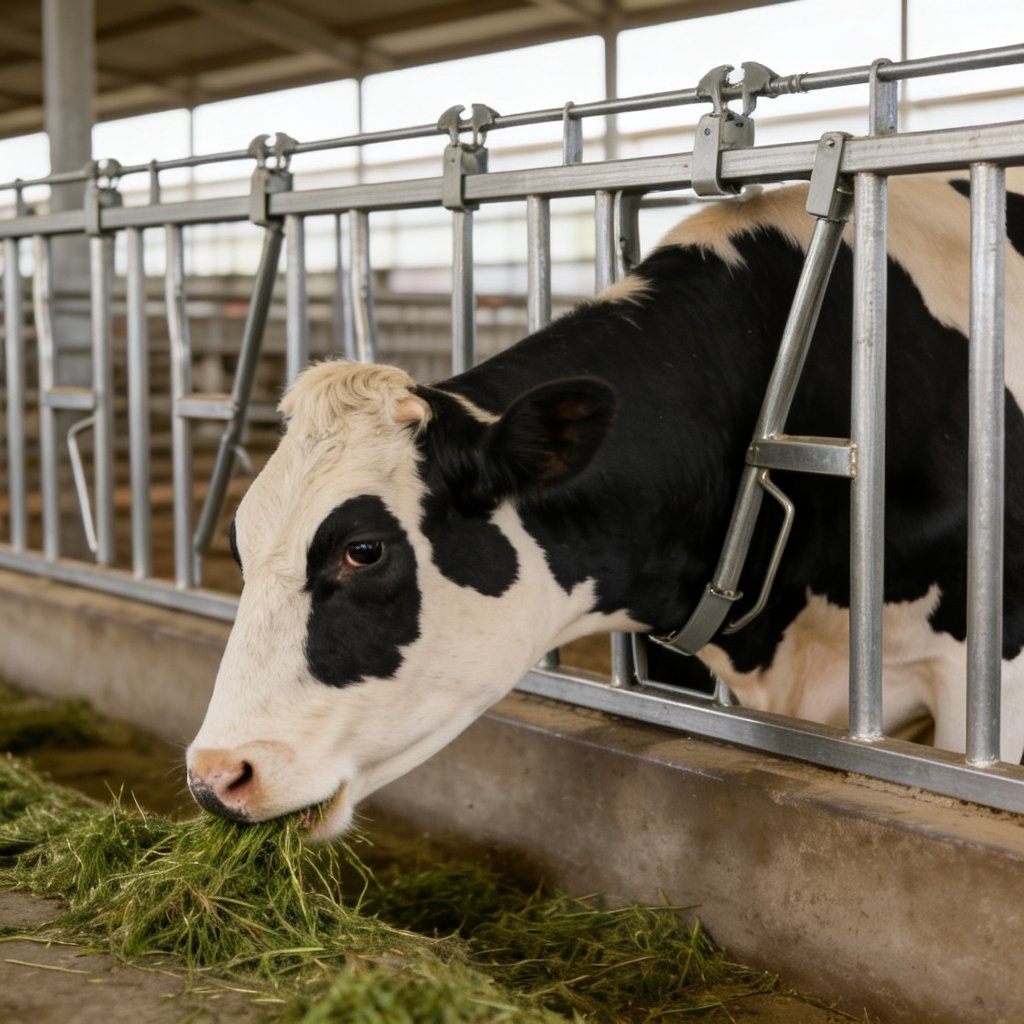
What Is a Self-Locking Cattle Headlock
A self-locking cattle headlock, also called a head gate or neck clamp, is a feed barrier system integrated into the feed bunk line. When a cow inserts her head through the opening to reach the feed, her neck presses against a moving bar inside the frame. This triggers a butterfly latch mechanism that locks her gently in place — without any human action required.
Once locked, the animal can eat freely but cannot withdraw until the operator releases the mechanism. This serves two distinct functions on a cattle farm. First, it creates feeding fairness — every cow has her own position, so dominant animals cannot steal feed from subordinates. This ensures each animal consumes its intended ration. Second, it enables hands-free handling — with the entire herd locked at the bunk, a single operator can walk the line to perform vaccinations, artificial insemination, pregnancy checks, ear tagging, and hoof inspections without roping, chasing, or penning individual animals.
According to livestock handling research, headlocks are commonly used as feed barriers to restrain cattle for health checks and management tasks (Source: Grandin, 2019).
Why Headlock Feed Barriers Matter for Herd Performance
The economics of bunk competition are steeper than most producers realize. When dominant cows push subordinates away from the bunk, the herd does not just lose fairness — it loses productivity.
Research published in the Journal of Dairy Science found that headlock feed barriers can reduce aggressive interactions at the feed bunk by approximately 21% , improving access to feed for subordinate cows (Source: DeVries et al., 2005). A subordinate cow that consistently gets her full ration produces more milk, maintains better body condition, and remains in the herd longer.
Beyond feeding fairness, the handling function delivers labor savings that compound daily. Tasks that previously required a team — rounding up cattle, moving them to a separate handling facility, restraining each animal individually — can be completed by a single person along the feed bunk. On many operations, this transforms herd health days from all-hands events into routine individual tasks.
Additional research on barrier design notes that properly designed self-locking systems can reduce injury risk and improve animal welfare when dimensions are adapted to cattle size (Source: Mounier et al., 2006).
How a Self-Locking Cattle Headlock Works
The mechanism is entirely mechanical. No electricity, no hydraulics. This means reliability is near total and maintenance is minimal.
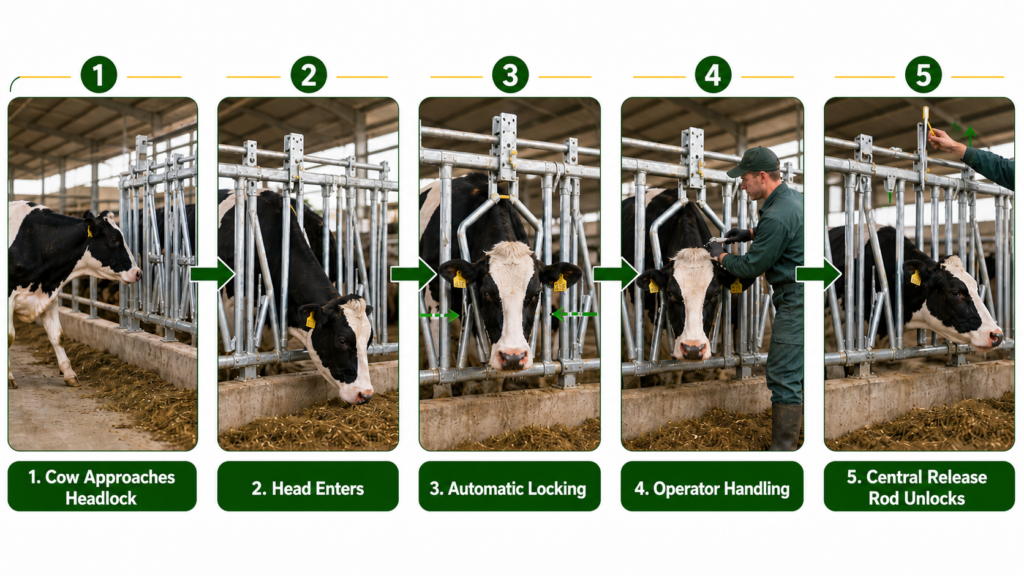
Step 1: Cattle Approach the Bunk
At feeding time, cattle walk up to the feed barrier. Each animal inserts its head through an individual opening to reach the TMR ration in the bunk. The opening is sized for comfortable entry but prevents turning or backing out once the lock engages.
Step 2: Automatic Locking Engages
As the cow lowers her head to eat, her neck presses against a moving bar inside the frame. This pivots the butterfly latch — a 3.5mm stamped galvanized steel plate — into the locked position. No manual action is needed. The cow is now gently secured.
Step 3: Controlled, Calm Feeding
With every animal locked in position, the bunk goes quiet. Dominant cows cannot push sideways to displace neighbors. Timid cows eat without harassment. The result is uniform intake across the herd, which translates into more consistent body condition and measurable improvements in milk production.
Step 4: Single-Operator Herd Handling
The operator walks along the alley behind the locked cattle. Each animal is already restrained. Vaccinations, AI breeding, pregnancy ultrasound scanning, ear tagging, and hoof trimming are performed efficiently. A task that once required a team can be completed by one person.
Step 5: Release Options
When handling is done, the operator slides the central release rod that runs along the top of the entire row. All butterfly latches rotate to the open position simultaneously, freeing the herd at once. For sorting, individual catches can be released one at a time — allowing separation of specific animals into a different pen while the rest remain locked.
How to Choose a Headlock Configuration That Fits Your Herd
Selecting headlocks that match an operation prevents costly retrofits and ensures safe handling for years. The most critical decisions fall into three areas.
Neck Spacing and Herd Composition
Neck spacing is the single most important specification — it determines whether animals are safely restrained or at risk of escape. The core principle: spacing must be sized for the smallest animal that will use a given section of the bunk. A row sized for adult Holsteins will let calves walk through; spacing meant for calves will choke a mature bull.
| Animal Type | Typical Neck Spacing |
|---|---|
| Adult beef breeds (Angus, Hereford, Brahman) | 19–20 cm |
| Adult Holstein dairy cows | 18–19 cm |
| Jersey cows | 16–17 cm |
| Yearlings and heifers (12–18 months) | 14–16 cm |
| Calves (3–8 months) | 11.5–13.5 cm |
Table 1: Typical neck spacing ranges by breed and age category
Mixed herds with multiple age groups can have different sections of the bunk line fabricated with different spacing — heifer spacing at one end, mature cow spacing at the other — so that all animals are safely handled.
Barn Layout and Climate Considerations
The physical environment shapes headlock choices. In existing barns, headlocks can be retrofitted onto existing feed bunk walls, provided the current wall is structurally sound and at the correct height. New construction offers full flexibility in placement and configuration.
Climate also matters. Headlocks installed in open-sided barns or outdoor feedlot bunks are fully exposed to weather year-round. In these conditions, material durability determines whether the equipment lasts a career or requires replacement every few years. Galvanized steel that passes extended salt spray testing resists corrosion far longer than painted alternatives.
Planning for Herd Growth
A common misstep when purchasing headlocks is sizing only for the current herd without considering future plans. Operations that are expanding or planning to introduce new genetics — switching from Jerseys to crossbreds, for example — may find that headlocks designed only for today’s smallest animals cannot accommodate tomorrow’s larger stock. Building flexibility into the initial investment is more economical than replacing sections later.
FAQ
Painted surfaces chip and peel within months in barn environments due to rubbing, manure acids, and pressure washing. Hot-dip galvanizing bonds metallurgically with the steel, creating a thick, abrasion-resistant barrier that remains intact for 15+ years even in high-moisture, corrosive conditions. It eliminates the recurring cost of annual repainting and the biosecurity risk of rust in feed areas.
A central release rod runs along the top of the entire headlock row. The operator slides this rod to open all locks simultaneously — freeing the entire herd in seconds. For sorting, individual catches can be released one at a time, allowing specific animals to be separated into a different pen while the rest remain locked.
Yes. Headlocks are designed for both new construction and retrofit installation. Provide the length and height of your existing feed bunk wall, and a mounting solution can be fabricated that bolts directly to the existing structure — no major demolition, no welding, no structural changes required.
While dehorning is recommended for herd safety, standard spacing and smooth, burr-free edges accommodate most horned breeds. For wide-horned breeds like Texas Longhorns or Ankole-Watusi, the curved yoke option or custom wider spacing ensures comfortable entry and exit without horn trapping.