
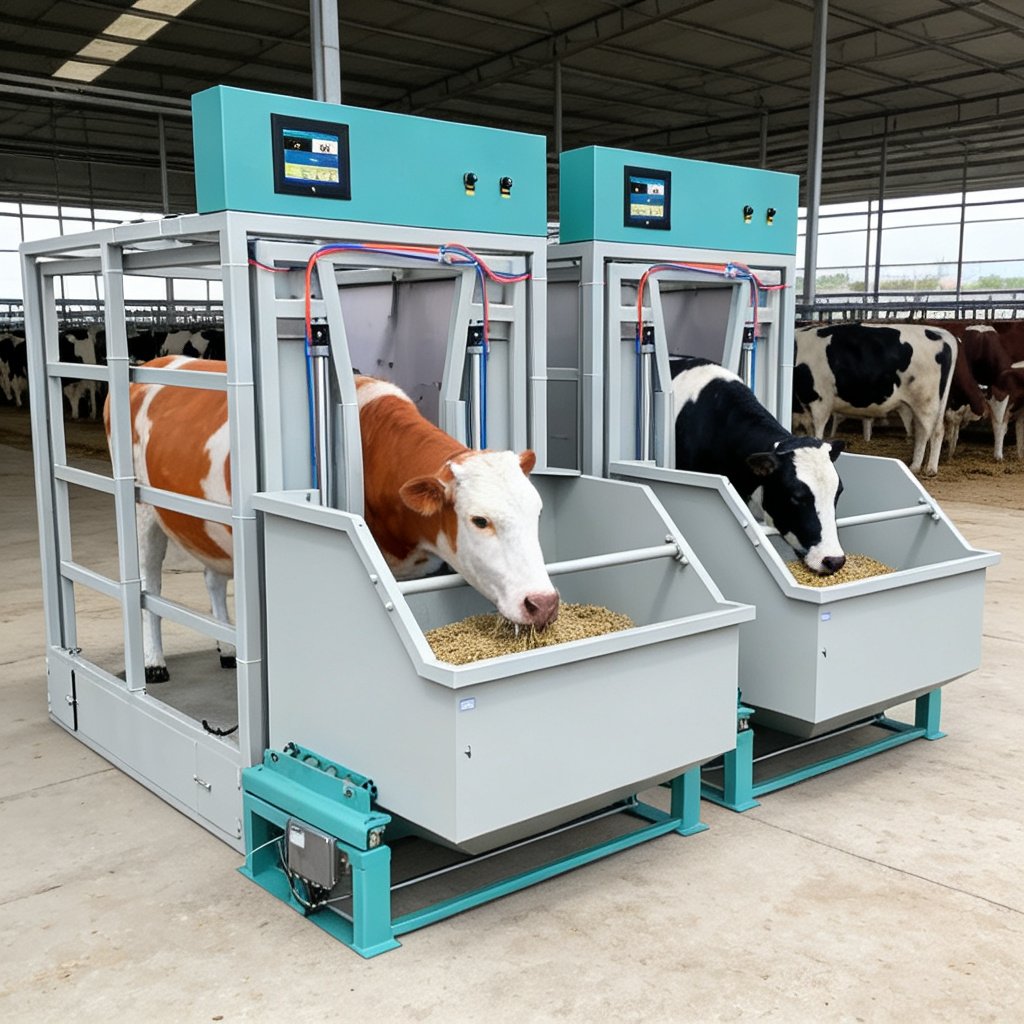
Stop guessing which animals convert feed most efficiently. Our automatic FCR monitoring system measures individual feed conversion ratio and daily weight gain in real time — giving you hard data to make profitable breeding and feeding decisions. The system combines RFID ear tag identification, high-precision load cells with 3‰ accuracy, and an onboard industrial computer that automatically calculates FCR — the kilograms of feed required per kilogram of body weight gained. Whether you run a bull test station, a dairy heifer research facility, or a commercial feedlot, this customizable system replaces visual estimates with individual performance data. Identify your top-performing genetics, optimize rations, and detect illness 24–48 hours before visible signs through instant feed intake drop alerts.
Why Choose This FCR Monitoring System
Short Benefits
- Real-time FCR calculation — automatically computes individual feed conversion ratio without manual data entry
- RFID identification with 99.9% accuracy — every data point ties to the correct animal
- 3‰ precision load cells — reliable weight and feed intake measurement even with animal movement
- Cloud data sync via 4G/WiFi — access performance reports from your phone, tablet, or computer anywhere
- Custom frame dimensions — built to your breed size, from Jerseys to Holsteins to Angus bulls
Suitable For
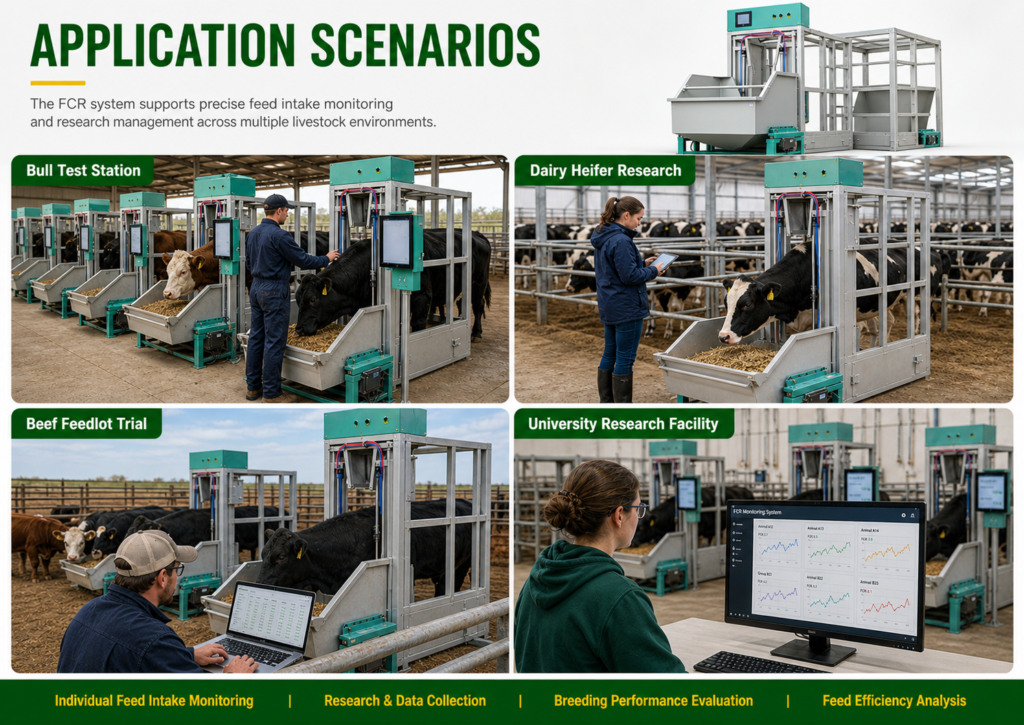
Bull test stations, dairy heifer research programs, beef feedlot trials, seedstock operations, and university research facilities.
Get a Tailored Livestock Equipment Solution
Tell us your farm size, layout, and requirements — we’ll recommend the most efficient setup for your operation.
What Is an Automatic FCR Monitoring System?
An automatic FCR monitoring system is a precision livestock tool that continuously tracks individual animal feed intake and body weight to calculate feed conversion ratio — the industry-standard metric for measuring how efficiently an animal turns feed into body mass. The system operates without human intervention: an animal enters the station voluntarily to access feed, its RFID ear tag is read instantly, the pneumatic head gate secures it gently, and load cells measure every gram of feed consumed and every kilogram of body weight. The onboard industrial PC computes FCR in real time and syncs data to the cloud. For bull test stations evaluating yearling performance, dairy replacement programs tracking heifer efficiency, or commercial feedlots comparing ration performance, this system replaces subjective visual assessment with objective data. It also detects illness early through sudden feed intake drops — often 24–48 hours before visible symptoms appear.
How It Works
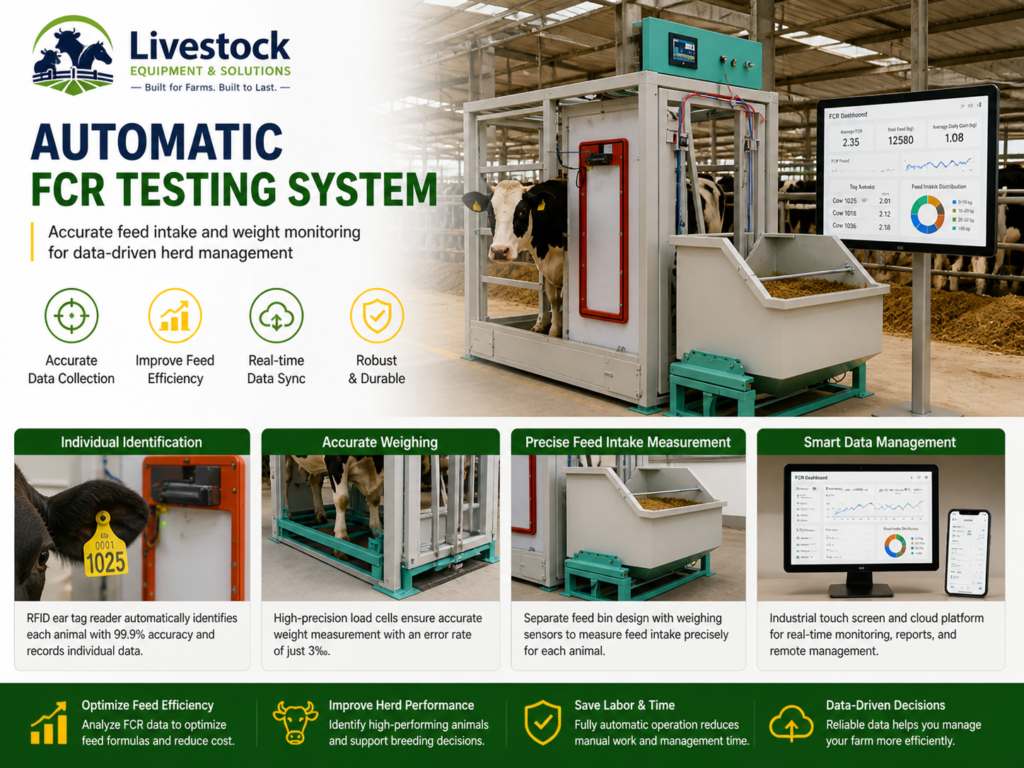
Automatic FCR Calculation & Data Upload: The onboard industrial PC combines feed intake and weight data to compute FCR in real time. Results sync automatically to the cloud. After the animal exits, the flip-feed bunk rotates to collect any refused feed, which is weighed separately to calculate true intake.
Animal Entry & RFID Identification: The animal approaches the station voluntarily, attracted by feed in the bunk. As it passes through the frame, the RFID reader captures its unique electronic ear tag ID with 99.9% accuracy, instantly pulling up that animal’s performance history.
Secure Feeding Position: The pneumatic head gate activates, gently securing the animal in the correct position. This ensures all feed consumed from the bunk is attributed to the correct individual, and the weigh platform records only this animal’s body weight.
Real-Time Feed Intake Measurement: The feed bunk rests on independent high-precision load cells. The system records initial feed weight and continuously measures disappearing feed. Spillage is minimized through a deep, contoured bunk design with side shields.
Body Weight Recording: The animal stands on a separate weigh platform with anti-vibration load cells delivering 3‰ precision. Weight is recorded automatically during feeding without requiring restraint or stress.
Application Scenarios
- Bull Test Stations: Evaluate yearling bulls under standardized conditions. Identify which sires produce the most efficient offspring by comparing FCR across bloodlines.
- Dairy Heifer Research: Track individual feed conversion efficiency in replacement heifers. Select genetics for cows that maintain body condition on lower feed inputs.
- Beef Feedlot Trials: Compare different rations, implants, or feed additives by measuring their effect on FCR. Optimize feeding programs based on individual data rather than pen averages.
- University & Government Research: High-accuracy data collection for nutritional, genetic, and welfare studies with complete audit trails for each animal visit.
Technical Specifications
| Component | Parameter | Specification |
|---|---|---|
| Identification | RFID Tag Reader | 99.9% Recognition Accuracy |
| Tag Compatibility | FDX-B / HDX Electronic Ear Tags | |
| Feed Measurement | Load Cell Precision | 3‰ (±0.3%) |
| Feed Bunk Type | Flip-Feed for Orts Collection | |
| Body Weight | Load Cell Precision | 3‰ Anti-Vibration |
| Weigh Platform | Heavy-Duty Steel Frame, Breed-Adjustable Width | |
| Animal Restraint | Head Gate Type | Pneumatic (Air-Operated), Adjustable Height |
| Onboard Computer | Display | Industrial Touchscreen PC |
| Connectivity | 4G / WiFi Cloud Sync | |
| Power Supply | — | Customizable: 220V / 380V |
| Customization | Frame Dimensions | Adjustable for Breed Size (Jersey, Holstein, Angus) |
| Number of Stations | Single Station to Multi-Station Networked Systems |
Automatic FCR vs Traditional Manual Measurement
| Feature | Traditional Manual Measurement | This Automatic FCR Monitoring System |
|---|---|---|
| Data Accuracy | Relies on periodic weighing and pen-average feed intake | Individual animal data with 3‰ load cell precision |
| Labor Requirement | High — manual capture, weighing, and recording | Fully automatic — no human intervention needed |
| Data Timeliness | Periodic (weekly or biweekly) | Real-time, continuous 24/7 monitoring |
| Individual Animal Data | Not possible for group-housed animals | RFID ensures every data point is tagged to the correct animal |
| Illness Detection | Visual, often 1–2 days after onset | Drop in feed intake triggers alert before visible symptoms |
| Feed Refusal Measurement | Not measured separately | Orts collected via flip-feed bunk for true intake calculation |
| Long-Term Data | Manual records, easily lost | Cloud-based, accessible anytime, never lost |
Common Questions
The pneumatic head gate secures one animal at a time in the correct position. The feed bunk is mounted on independent load cells separate from the body weight platform, measuring feed disappearance continuously. After the animal exits, any refused feed (orts) remaining in the bunk can be weighed by flipping the bunk. The system calculates true intake as: Total Feed Offered minus Orts equals Actual Intake.
Yes. The FCR station is designed for individual animal access controlled by the RFID-triggered pneumatic head gate. While the station can be placed in a pen where animals live as a group, only one animal occupies the station at a time — ensuring every data point is attributed to the correct individual.
One station can effectively monitor 15–25 animals, depending on the testing protocol and daily feeding duration. For larger groups, multiple stations can be networked together and managed from a single dashboard.
A 3‰ (0.3%) accuracy on a 600 kg animal means weight measurement is accurate within ±1.8 kg. This level of precision is sufficient to detect meaningful daily weight changes over a standard 70-day bull test period, providing reliable data for calculating Average Daily Gain and FCR.
The onboard industrial touchscreen PC stores all data locally and continues collecting data without interruption even if the internet connection drops. Internet access via 4G or WiFi is required only for cloud synchronization and remote viewing on your phone or computer.
A sudden drop in feed intake is one of the earliest signs of illness in cattle, often occurring 24–48 hours before visible symptoms like fever or lethargy. The system monitors each animal’s feeding pattern and triggers an alert when intake drops significantly below that individual’s normal baseline — allowing you to intervene before the animal becomes visibly sick.
About Us
- Experience: 10 years of livestock equipment manufacturing since 2016, with a 5,000m² production facility and 8 dedicated production lines.
- Quality Standards: Industrial-grade load cells and RFID readers designed for daily use by large, aggressive cattle. Every system undergoes dimensional verification before shipment.
- Customization: We adjust frame width, head gate height, bunk depth, and power supply to your specific breed and facility layout — from Jerseys to Holsteins to Angus bulls.
- Support: Every order includes detailed CAD layout drawings, installation manuals, and pre-shipment photo and video verification. Remote setup guidance, data platform training, calibration support, and spare parts sourcing included.