
Clean, ice-free water in winter is not a luxury on a livestock farm — it is a daily operational necessity. When ambient temperatures drop below freezing, standard water troughs form a layer of ice that must be broken manually before animals can drink. A heated livestock water trough eliminates this chore entirely, maintaining open water at temperatures that support normal feed intake and rumen function even in extreme cold.
But not all heated troughs are built to the same standard. The difference between a trough that lasts fifteen winters and one that fails after three comes down to material quality, insulation design, heating safety, and ease of maintenance. This guide explains how a heated trough works, why warm water matters for cattle and sheep performance, and which features separate a reliable long-term investment from a recurring maintenance headache.
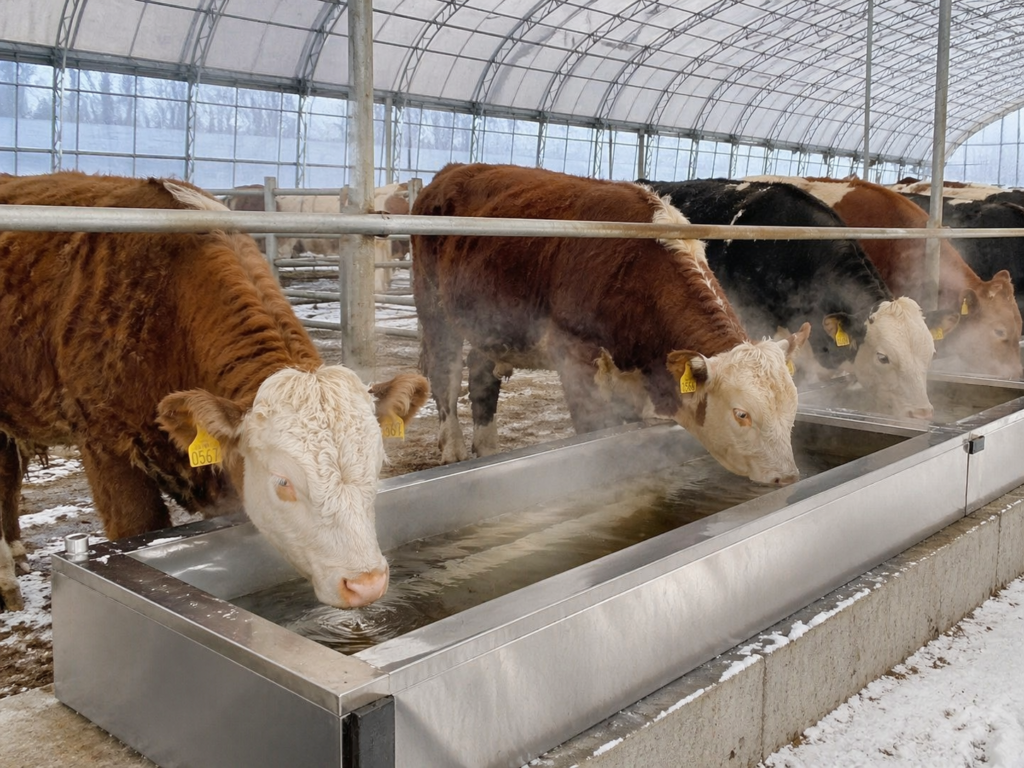
What Is a Heated Livestock Water Trough
A heated livestock water trough is a drinking station designed to prevent water from freezing in cold weather while maintaining a temperature range that encourages adequate consumption. Unlike standard galvanized tanks that rely solely on ambient warmth, a heated trough uses an integrated heating element controlled by a thermostat, combined with high-density polyurethane insulation between double-layer stainless steel walls. This creates a system that keeps water liquid and temperate without continuously running the heater at full power.
Heated troughs serve all major livestock species — cattle, horses, sheep, and goats — and are available in custom lengths to match pen dimensions. They connect to a standard water supply via a float valve, automatically refilling as animals drink and eliminating the daily labor of hauling hoses or breaking ice.
Why Water Temperature Matters for Livestock Productivity
The connection between water temperature and animal performance is well documented. A USDA Agricultural Research Service study demonstrated that cattle provided with warm drinking water consumed significantly more water and maintained more stable rumen conditions during winter (Source:USDA ARS, 2016).
When cattle drink near-freezing water, the energy required to warm that water to body temperature is energy not available for growth or lactation. The result is a measurable drop in feed conversion efficiency and, in dairy cows, a reduction in milk output. Research indicates that heated water reduces time that rumen temperature falls below optimal levels, improving growth performance in cattle (Source:PMC10451963, 2023).
The practical takeaway: access to warm water in winter supports feed intake, stabilizes rumen function, and helps maintain production targets when cold stress would otherwise pull performance down. Studies on dairy cattle show that water temperature and environmental stress significantly affect drinking frequency and intake behavior (Source:ResearchGate, 2010).
How a Heated Water Trough Works
A heated trough operates on three integrated systems that work together to maintain open, temperate water without excessive energy use.
The Insulation System
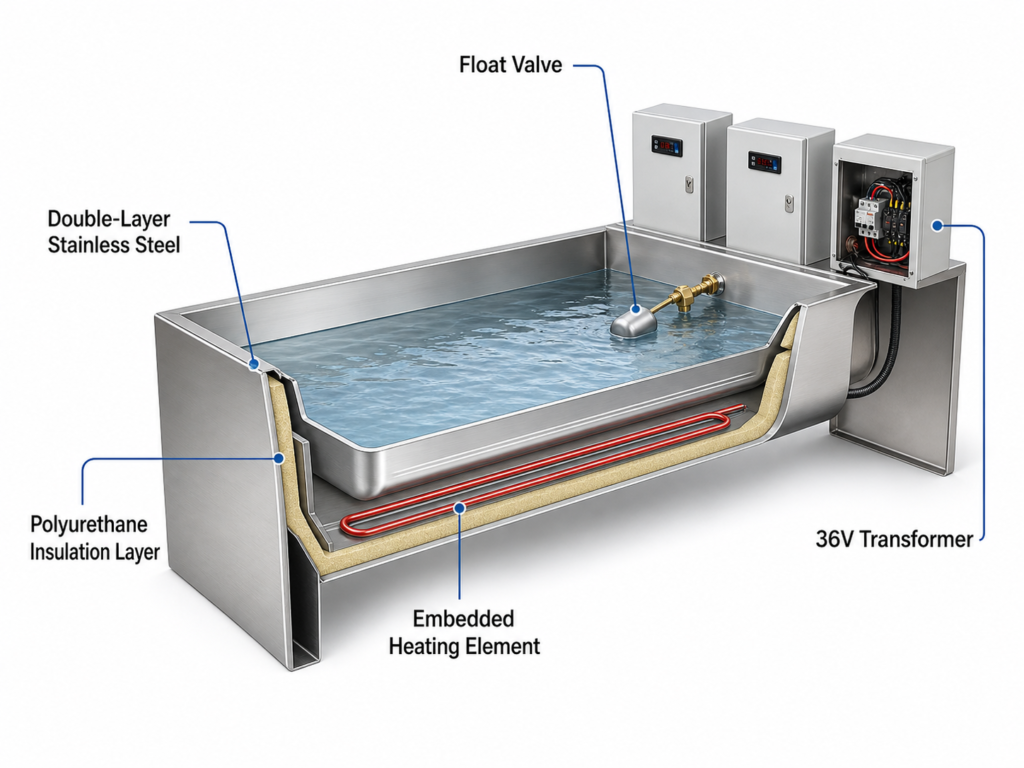
The trough body consists of two 304 stainless steel layers — an inner tub that holds the water and an outer shell — separated by 4–5 cm of high-density polyurethane foam. This closed-cell foam acts as a thermal barrier, dramatically slowing heat loss from the water to the surrounding cold air. Even without the heating element active, the insulation alone can delay freezing for many hours.
The Heating System
An electric heating element — available in 800W or 1600W configurations depending on trough size and climate severity — is embedded between the inner and outer steel layers. It never contacts water directly. A thermostat cycles the element on only when needed to maintain the target water temperature of approximately 10–15°C, rather than running continuously. A digital temperature control box displays real-time water temperature and allows the operator to adjust the set point.
The Safety System
A built-in transformer converts the standard 220V supply to 36V at the trough — a safe voltage for livestock. An earth leakage circuit breaker (DZ47-63) provides additional protection against electrical faults.
The Water Supply System
A one-piece moulded float valve connects to the farm water supply and automatically maintains the water level as animals drink. The float chamber is protected by a stainless steel cover that prevents animals from tampering with the mechanism, but the operator can open it without tools for inspection and cleaning.
How to Choose a Heated Water Trough That Lasts
A heating element and a thermostat alone do not make a reliable winter waterer. The best heated troughs share several design characteristics that determine longevity, operating cost, and daily usability.
Stainless Steel Construction — Inner and Outer Layers
The ideal trough uses 304 food-grade stainless steel for both the inner tub and the outer shell. A double-layer design provides a sealed cavity for the insulation and prevents corrosion from both the water side and the barn environment. Stainless steel is non-porous — it resists algae and bacterial biofilm buildup that can foul standard galvanized surfaces, and it is straightforward to clean with standard barn washing equipment.
Insulation Thickness and Material
At least 4–5 cm of closed-cell polyurethane foam should separate the inner and outer steel layers. Thinner insulation or open-cell foam allows too much heat loss. In practical terms, a well-insulated trough with a properly calibrated thermostat keeps water liquid at ambient temperatures down to -30°C. Independent operational testing has verified that insulated, heated troughs maintain open water at temperatures as low as -20°C under controlled conditions (Farmtec operational test data).
Heating Safety and Voltage
Any electric device in a wet barn environment must prioritize safety. Look for a design where the heating element is embedded in the wall, not exposed to water. A transformer that reduces supply voltage to 36V at the trough provides an additional layer of protection. A residual-current circuit breaker should be integrated into the control box, not sold as an optional extra.
Automatic Refill and Drainage
A float valve connected to the farm water supply eliminates manual filling. The float housing should be accessible for cleaning but protected from animal interference. A large-diameter drain plug at the lowest point of the trough allows rapid emptying for periodic deep cleaning — a trough that drains slowly or traps sediment will be cleaned less often, and water quality will suffer.
Custom Length for Pen Fit
Standard off-the-shelf troughs come in fixed lengths — 2m, 3m, or 4m — that may leave gaps or require awkward pen modifications. Custom-length fabrication ensures the trough fits the exact pen dimensions, providing continuous water access along the full feed bunk or fence line without dead zones.
Common Questions
A well-insulated heated trough with 4–5 cm of polyurethane foam between double-layer stainless steel walls can maintain liquid water at ambient temperatures down to -30°C (-22°F). The thermostat cycles the heating element only as needed rather than running continuously, so energy consumption remains modest even in extreme cold.
No. In a properly designed heated trough, the heating element is embedded between the inner and outer stainless steel walls, separated from the water by the inner tub. A built-in transformer reduces supply voltage to 36V at the trough, and an earth leakage circuit breaker adds further protection. This design eliminates the risk of electrical shock to animals and extends the life of the heating element.
Yes. Custom-length fabrication is standard practice. Troughs can be manufactured to any length — 2.5m, 3.6m, 5.2m — to match existing pen dimensions exactly. This avoids the gaps and wasted space that occur when standard-length troughs are installed in non-standard pen layouts.
Energy consumption depends on ambient temperature, trough size, and insulation quality. In -15°C conditions, a 3-meter cattle trough with 5 cm of polyurethane insulation typically averages 200–400W under thermostatic control. The heater does not run continuously — it cycles on and off to maintain the target water temperature of 10–15°C.