
Feed is the single largest expense on any cattle farm, often accounting for 60–70% of total production costs. For ranchers, feedlot managers, and dairy operators, even a small improvement in how efficiently animals turn feed into body weight can mean the difference between profit and loss. This is where Feed Conversion Ratio (FCR) comes in — it is the most direct measure of whether your feeding program is working or wasting money.
Yet on many operations, FCR is still tracked with pen-wide averages, periodic manual weighing, or simple visual estimates. None of these methods tell you which individual animals are pulling their weight and which ones are quietly draining your feed budget. Understanding what feed conversion ratio is, how it is calculated, and how modern monitoring tools are changing the game gives cattle producers a clearer path to improved feed efficiency and better margins.
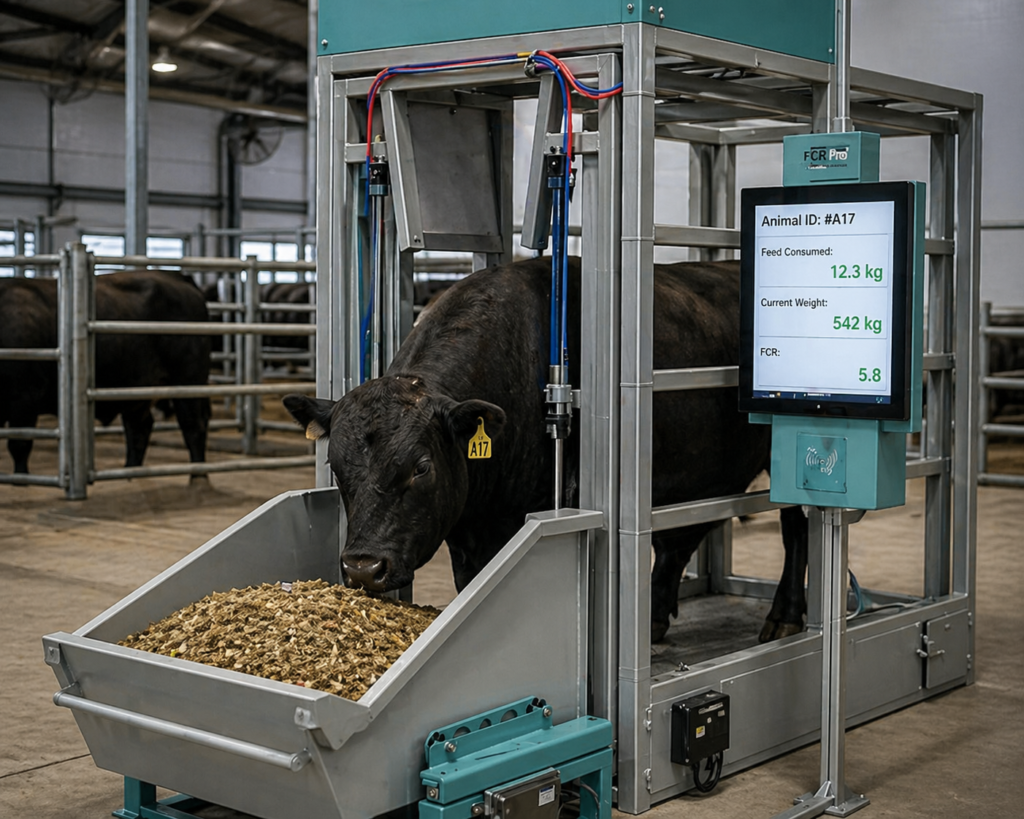
What Is Feed Conversion Ratio (FCR)
Feed Conversion Ratio (FCR) is a simple formula that measures how many kilograms of feed are required to produce one kilogram of body weight gain. A lower FCR means a more efficient animal — one that gains the same weight on less feed. In the cattle industry, FCR is the most widely used metric for evaluating feed conversion efficiency and comparing performance across individual animals, pens, or entire feeding programs.
According to livestock science, feed conversion ratio represents the efficiency of converting feed into animal output such as body mass or milk.
Source: https://en.wikipedia.org/wiki/Feed_conversion_ratio
FCR Formula and Basic Calculation
| Indicator | Explanation |
|---|---|
| Feed Intake | Total dry matter consumed over a given period (kg) |
| Weight Gain | Total body weight gained over the same period (kg) |
| FCR | Feed Intake ÷ Weight Gain |
*Table 1: Basic components of the Feed Conversion Ratio formula*
For example, if a steer eats 10 kg of feed per day and gains 1.2 kg, its FCR is 8.3:1. If another steer eats the same 10 kg but gains 1.5 kg, its FCR is 6.7:1. The second animal is significantly more profitable — producing the same output with roughly 20% less feed cost. This is why understanding your FCR ratio is critical: it directly ties feed conversion rate to financial performance.
In beef production, FCR typically ranges from 5:1 to 10:1 depending on breed, diet, age, and management. Dairy systems track a related metric — feed efficiency, measured as kilograms of milk produced per kilogram of dry matter consumed.
Why Feed Conversion Ratio Matters for Cattle Profitability
Feed costs dominate any cattle operation’s budget. When every kilogram of feed counts, understanding and improving feed conversion ratio for cattle becomes a direct driver of financial performance.
Consider a 1,000-head feedlot finishing 500 kg steers:
| Scenario | FCR | Feed Needed per Steer (kg) | Total Feed for 1,000 Head (kg) |
|---|---|---|---|
| Current Average | 7.5:1 | 3,750 | 3,750,000 |
| After Improvement | 6.8:1 | 3,400 | 3,400,000 |
| Feed Saved | — | 350 kg/head | 350,000 kg |
*Table 2: Impact of a 0.7-point FCR improvement on a 1,000-head feedlot*
At conservative feed prices, this represents thousands of dollars in annual savings — from a single-point FCR improvement. This is why operations that actively measure and improve feed conversion consistently outperform those that rely on visual estimates alone.
Monitoring cattle feed efficiency helps producers go deeper than simple weight tracking:
- Identify which bloodlines consistently convert feed more efficiently — informing breeding and culling decisions
- Evaluate whether a new ration, supplement, or implant strategy is actually improving performance
- Detect health issues early — a sudden drop in feed intake often precedes visible symptoms by 24–48 hours
Research published in Animals (2023) confirms that feed intake data and animal behavior monitoring can be used to estimate and optimize feed conversion ratio (FCR) (Source: Cheng et al., 2023).
This is why automated monitoring is becoming a critical component of precision livestock farming — it turns guesswork into data points.
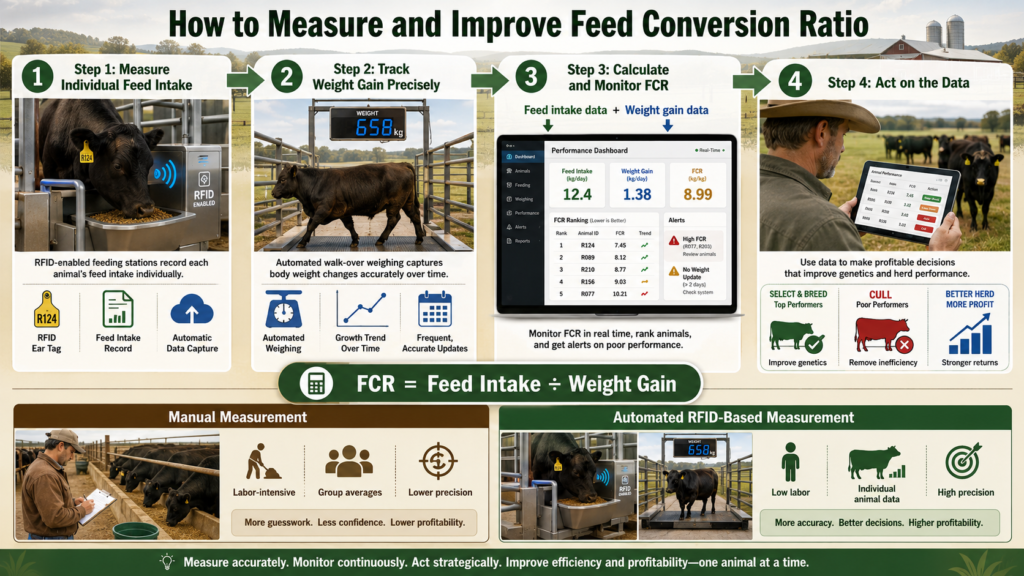
How to Measure and Improve Feed Conversion Ratio
Improving FCR starts with accurate measurement. Without individual animal data, you are making decisions based on group averages that hide the variation within your herd. Here is a practical step-by-step approach to calculating and improving feed conversion efficiency on your operation.
Step 1: Measure Individual Feed Intake
Group-fed cattle make it nearly impossible to know which animals are eating how much. Individual feeding stations equipped with RFID ear tag readers can record exactly how much feed each animal consumes per visit. This is the foundation of any feed efficiency testing program and the first step in applying a reliable feed efficiency formula.
Step 2: Track Weight Gain Precisely
Periodic weighing on a standard scale gives you snapshots, but automated walk-over weighing platforms capture weight every time an animal passes through — providing daily or even hourly growth data. Combined with feed intake data, this paints a complete picture of each animal’s feed conversion rate.
Step 3: Calculate and Monitor FCR
Modern systems integrate feed intake and weight data to compute FCR in real time. There is no manual data entry, no transcription errors, and no waiting for monthly reports. The system tells you daily which animals are performing and which are falling behind. For operations asking how to calculate feed conversion ratio efficiently, automated monitoring provides the answer.
A review by the University of Nebraska-Lincoln explains that the combination of electronic identification and automated feeding equipment allows individual feed intake recording on growing cattle, generating the data needed for genetic evaluation of feed efficiency (Source: Weaber, 2025, University of Nebraska-Lincoln Extension).
| Measurement Method | Accuracy | Labor Need | Data Type | Best For |
|---|---|---|---|---|
| Manual observation & periodic weighing | Low–Medium | High | Group averages | Small herds, limited budget |
| RFID-based individual feeding stations | High | Low | Individual, real-time | Bull test stations, seedstock, research |
*Table 3: Comparison of manual vs. automated FCR measurement methods*
Step 4: Act on the Data
Individual FCR data allows you to rank animals by efficiency, cull poor performers, and select breeding stock from your most efficient bloodlines. This is a compounding advantage — every generation bred from efficient parents improves your herd’s baseline profitability. For operations tracking feed conversion ratio for beef cattle or dairy replacements, this data-driven approach replaces decades of visual guesswork with measurable genetic progress.
| Key Point | Summary |
|---|---|
| What is FCR | Measures kg of feed per kg of body weight gain. Lower = more efficient |
| Why it matters | Feed is 60–70% of costs; small FCR improvements save thousands |
| How to improve | Measure individual intake, track weight gain, calculate FCR, select best genetics |
| Key tool | RFID-based monitoring systems provide automatic, real-time FCR data |
Common Questions
In commercial feedlots, a typical feed conversion ratio for beef cattle ranges from 5.5:1 to 7.5:1 for finishing cattle on high-grain diets. Grass-fed or backgrounding cattle may have FCRs of 8:1 to 12:1 depending on forage quality and breed. The average feed conversion ratio for beef cattle varies significantly by production system — meaning the most useful benchmark is comparing animals within your own operation to identify your best performers.
FCR measures feed consumed per unit of gain (lower is better). Feed conversion efficiency is often expressed inversely — gain per unit of feed consumed (higher is better). Both measure the same concept from different angles. In cattle operations, FCR remains the most commonly used metric because it directly ties feed cost to output.
Yes. Several management factors influence cattle feed conversion beyond genetics: feed bunk management (reducing sorting and waste), consistent water access, heat stress mitigation, parasite control, and implant strategies all play roles. However, the most sustainable long-term improvement comes from identifying and breeding from your most efficient animals — which requires individual performance data.