
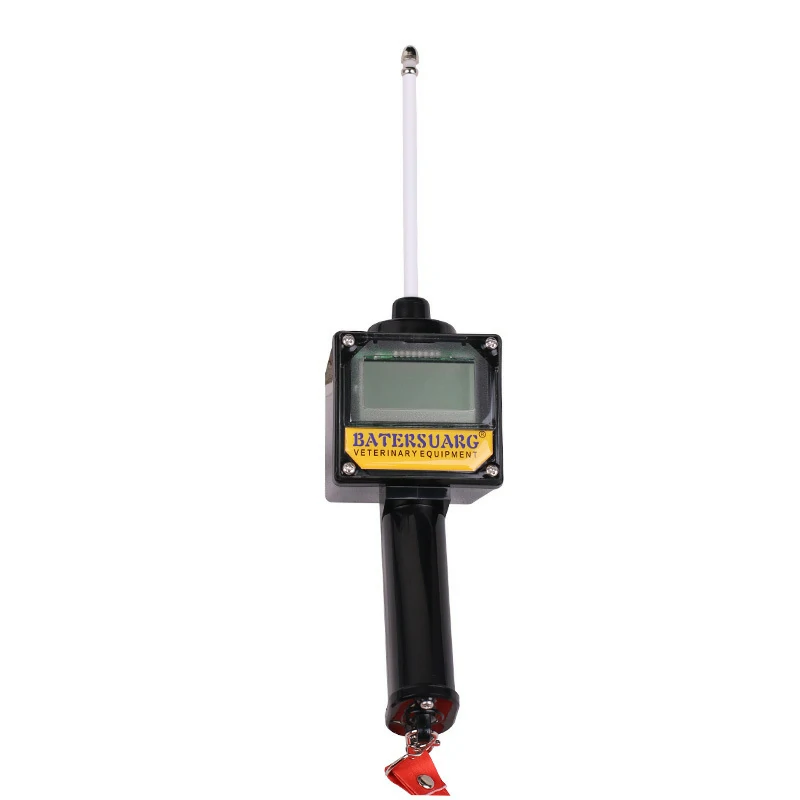
This animal ovulation detector is a handheld breeding management tool for pigs, cattle, sheep, horses, donkeys and other farm animals. It helps farms and veterinary breeding teams monitor estrus-stage changes, support ovulation timing decisions and improve breeding-window management. With a 405 mm probe, LCD display, automatic single-test operation and fast reading within 3 seconds, it is suitable for daily reproduction management on livestock farms.
Product Overview
This animal ovulation detector is designed for livestock farms, breeding centers, veterinary service teams and farm managers who need a practical tool for estrus-stage and ovulation-timing reference. It is suitable for pigs, cattle, sheep, horses and donkeys, helping breeding teams make more informed decisions during reproductive management.
The device uses a handheld structure with a long probe and LCD screen. During use, the detector collects a reading from the animal reproductive tract environment and displays the result on the screen. Farms can use the reading as a management reference together with animal behavior, breeding records, farm routines and veterinary guidance.
This product should be used as a breeding management aid, not as a standalone medical diagnosis device. It is most useful when combined with good observation, record keeping, proper animal handling and scheduled breeding management.
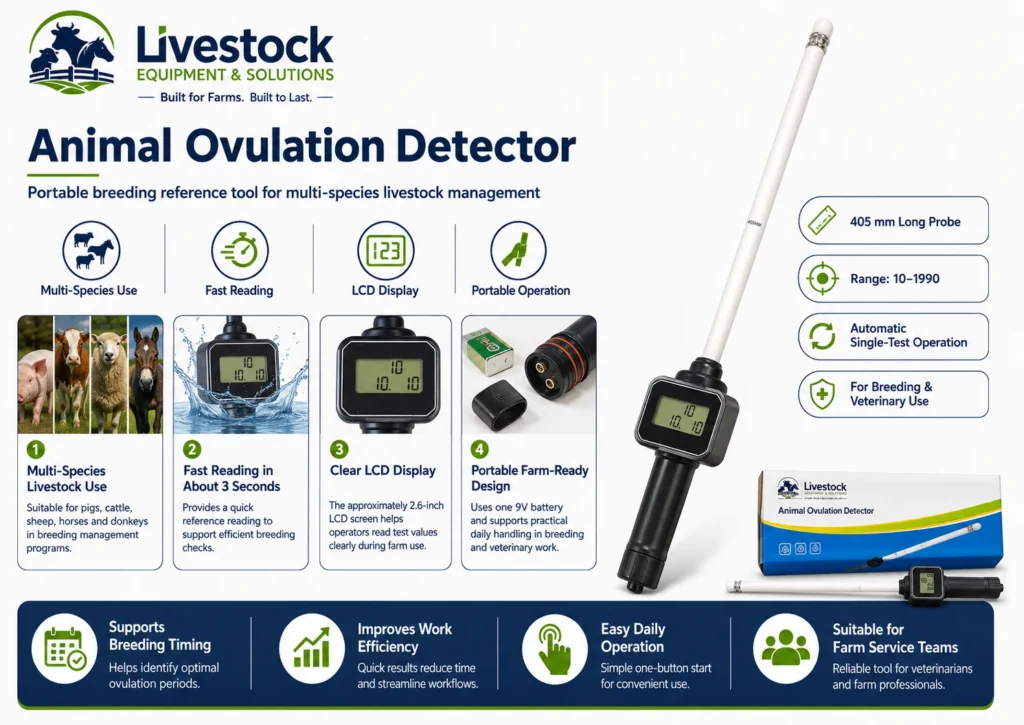
Product Features
- Multi-Species Livestock Use: Suitable for pigs, cattle, sheep, horses and donkeys in breeding management programs.
- 405 mm Long Probe: The long probe design supports use with different farm animals and breeding management workflows.
- LCD Display: The approximately 2.6-inch LCD screen helps operators read test values clearly during farm use.
- Fast Reading Within 3 Seconds: The detector provides a quick reference reading, helping farms work more efficiently during breeding checks.
- Automatic Single-Test Operation: The device supports fully automatic single-test operation for simpler daily use.
- Wide Measuring Range: The measuring range of 10–1990 supports estrus-stage reference and reproductive management tracking.
- 9V Battery Power: The detector uses one 9V 6F22 battery, making it convenient for portable farm operation.
- Farm-Ready Body Design: The device is designed for practical farm handling and routine livestock breeding environments.
- Breeding Window Support: Helps farms compare animal status, observation records and reading trends when planning breeding timing.
- Veterinary Service Use: Suitable for breeding technicians, farm operators and veterinary service teams working with multiple animal types.
Configuration Options
| Configuration | Best For | Main Advantage | Buyer Notes |
| Standard Animal Ovulation Detector | General livestock breeding use | Covers pigs, cattle, sheep, horses and donkeys | Confirm target animal before order |
| Breeding Farm Use Set | Farms with routine estrus monitoring | Practical for repeated breeding checks | Confirm quantity and operation workflow |
| Veterinary Service Set | Mobile veterinary and breeding technicians | Easy to carry between farms or barns | Confirm packaging and spare accessories |
| Distributor Package | Dealers and farm equipment suppliers | Suitable for bulk supply and localized instruction support | Confirm language, packaging and documentation needs |
| Training Support Option | New farm users | Helps operators understand operation flow and reading reference | Confirm instruction material requirements |
Product Comparison
| Feature | Animal Ovulation Detector | Portable Veterinary Ultrasound | Visual Estrus Observation |
| Main Use | Estrus-stage and ovulation timing reference | Pregnancy imaging and reproductive examination | Behavioral heat detection |
| Output Type | Numerical reading on LCD screen | Ultrasound image | Farm observation record |
| Typical Use Stage | Before breeding or during estrus monitoring | After breeding for pregnancy checking | Before breeding |
| Suitable Users | Breeding farms, technicians and veterinary service teams | Veterinarians, trained technicians and reproduction teams | Farm workers and herd managers |
| Animal Coverage | Pigs, cattle, sheep, horses and donkeys | Depends on probe and model configuration | Depends on farm observation routine |
| Main Advantage | Fast reference reading and portable operation | Visual reproductive imaging | No equipment required |
| Main Limitation | Should be used as a management aid, not a standalone diagnosis | Requires image interpretation and suitable probe | Can miss silent or unclear estrus |
| Best Practice | Combine with observation and breeding records | Combine with reproduction program | Combine with tools and records where needed |
Technical Specifications
| Item | Available / Reference Specification |
| Product Type | Animal ovulation detector / livestock estrus detector |
| Suitable Animals | Pigs, cattle, sheep, horses and donkeys |
| Probe Length | 405 mm |
| Gross Weight | 700 ± 10 g |
| Display | LCD screen, approximately 2.6 inches |
| Battery | One 9V battery, 6F22 type |
| Working Temperature | 0–50°C |
| Maximum Humidity | 85% |
| Test Method | Fully automatic single test |
| Reading Speed | Within 3 seconds |
| Measuring Range | 10–1990 |
| Use Direction | Estrus-stage support, ovulation timing reference and breeding management |
| Suggested Users | Livestock farms, breeding farms, veterinary service teams and reproduction technicians |
Reading Reference Use
| Use Area | Practical Meaning |
| Estrus Monitoring | Helps operators compare reading changes during the animal breeding cycle |
| Breeding Timing Support | Provides a numerical reference for breeding-window management |
| Reproductive Record Support | Can be used together with farm breeding records and animal behavior observation |
| Farm Management Aid | Helps reduce guesswork when monitoring multiple breeding animals |
| Veterinary Service Support | Can support field breeding services when combined with professional judgment |
Note: This detector provides reference readings for livestock breeding management. It should be used together with farm records, animal behavior observation and veterinary guidance. It is not a substitute for professional medical diagnosis or treatment.
How to Use the Animal Ovulation Detector
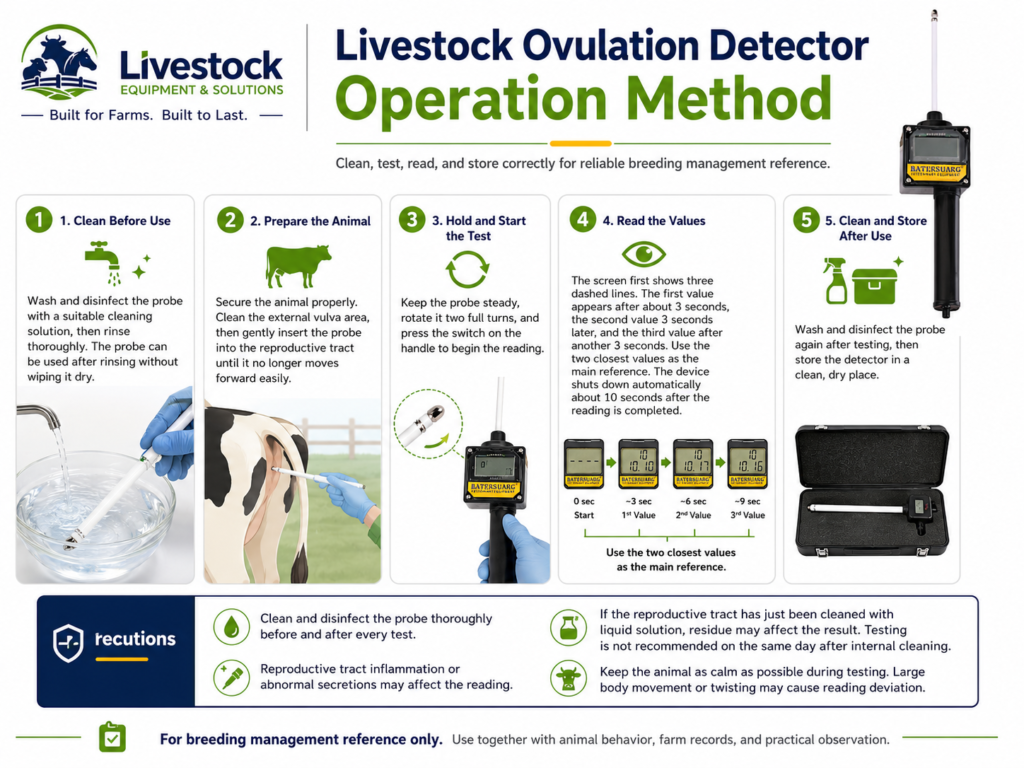
Use the animal ovulation detector as a breeding management support tool for pigs, cattle, sheep, horses, and donkeys. Proper cleaning, calm animal handling, and consistent operation are important for more stable readings.
Operation Method
- Clean the detector before use.
Wash and disinfect the probe with a suitable cleaning solution, then rinse it thoroughly. The probe can be used directly after rinsing, without wiping it dry. - Prepare and restrain the animal.
Secure the animal properly. After cleaning the external vulva area, gently insert the probe into the reproductive tract until it can no longer move forward easily. - Hold the probe in position.
Keep the probe steady, rotate it two full turns, and press the switch on the handle to start the reading. - Read the values correctly.
The screen will first display three dashed lines. The first value appears after about 3 seconds, the second value appears 3 seconds later, and the third value appears after another 3 seconds. Use the two closest values as the main reference. The device automatically shuts down about 10 seconds after the reading is completed. - Clean and store after use.
Wash and disinfect the probe again after testing, then store the detector in a clean and dry place.
Precautions
- Clean and disinfect the probe thoroughly before and after every test.
- Reproductive tract inflammation may cause abnormal secretions and may affect the reading.
- If the reproductive tract has just been cleaned with liquid solution, residue may affect the result. Testing is not recommended on the same day after internal cleaning.
- During testing, keep the animal as calm as possible. Large body movement or twisting may cause reading deviation.
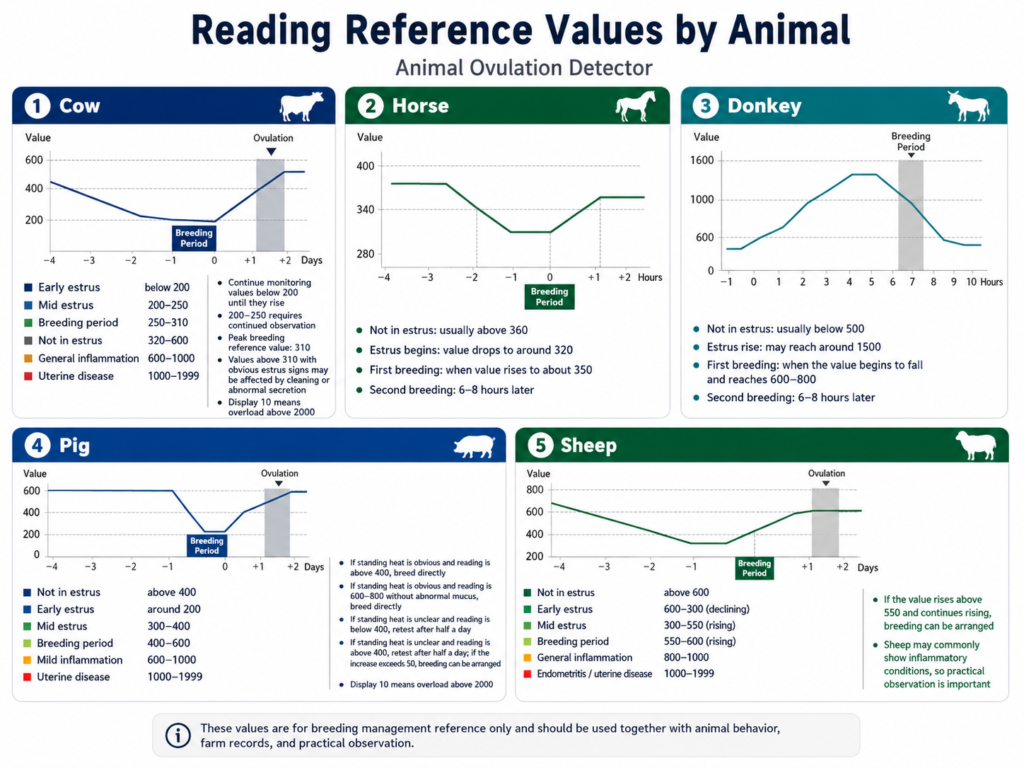
Reading Reference by Animal
The following values are reference readings for breeding management support. They should be used together with animal behavior, farm records, and practical breeding observation. They are not a substitute for professional veterinary diagnosis.
Cow Reference Reading
- Early estrus: below 200
- Mid estrus: 200–250
- Breeding period: 250–310
- Not in estrus: 320–600
- General inflammation: 600–1000
- Uterine disease: 1000–1999
Notes:
- Values below 200 should be followed with continued monitoring until the reading rises.
- For readings between 200 and 250, continued observation is recommended, or breeding can be combined with heat induction management where appropriate.
- A peak breeding reference value of around 310 is recommended.
- If a cow with obvious estrus signs tests above 310, check whether cleaning was sufficient or whether abnormal secretion or inflammation may be affecting the result.
- A display of 10 indicates an overload value above 2000.
Horse Reference Reading
- Horses not in estrus usually read above 360.
- When estrus begins, the value starts to drop and may fall to about 320.
- When the value rises again to around 350, the first breeding can be arranged.
- The second breeding can be arranged 6–8 hours later.
Donkey Reference Reading
- Donkeys not in estrus usually read below 500.
- When estrus begins, the value starts to rise and may reach around 1500.
- When the value starts to fall and reaches 600–800, the first breeding can be arranged.
- The second breeding can be arranged 6–8 hours later.
Pig Reference Reading
- Not in estrus: above 400
- Early estrus: around 200
- Mid estrus: 300–400
- Breeding period: 400–600 (if standing heat is obvious, breeding can be arranged directly)
- Mild inflammation: 600–1000
- Uterine disease: 1000–1999
Notes:
- If the sow shows obvious standing heat and the reading is above 400, breeding can be arranged directly.
- If standing heat is obvious and the reading is 600–800 without abnormal mucus, breeding can still be arranged directly.
- If standing heat is not obvious and the reading is below 400, test again after half a day. If it rises above 400, breeding can be arranged.
- If standing heat is not obvious and the reading is above 400, test again after half a day. If the increase is more than 50, breeding can be arranged.
- A display of 10 indicates an overload value above 2000.
Sheep Reference Reading
- Not in estrus: above 600, or the value remains stable at one level after the estrus period has passed
- Early estrus: 600–300, with a continuous downward trend
- Mid estrus: 300–550, with a continuous upward trend
- Breeding period: 550–600, with a continued upward trend
- General inflammation: 800–1000, often with abnormal discharge
- Endometritis or uterine disease: 1000–1999 (or display 10 in overload situations)
Notes:
- Continuous testing is recommended. If the value rises above 550 and continues rising, breeding can be arranged.
- Sheep are often in estrus and may also commonly show inflammatory conditions, so practical observation is important.
Applications
- Pig Breeding Farms: Used to support estrus and ovulation timing reference during sow breeding management.
- Cattle Breeding Programs: Suitable for cattle farms that need additional reference data during estrus monitoring.
- Sheep Breeding Management: Can support breeding-window management in sheep farms and small ruminant operations.
- Horse Breeding Facilities: Useful as a reproductive management aid for horse breeding programs.
- Donkey Breeding Farms: Can be used in donkey breeding and reproductive monitoring scenarios.
- Veterinary Field Service: Suitable for technicians and veterinary service teams working across different farms.
- Breeding Record Programs: Can be used together with animal ID records, breeding history and farm observation notes.
- Scale Farm Reproduction Management: Supports farms that need more structured breeding routines for multiple animals.
- Training and Farm Standardization: Useful for farms building a more consistent estrus monitoring workflow.
Recommended Reading
Use these guides to better understand livestock reproduction tools, pregnancy checking, and herd monitoring before choosing breeding management equipment.
- What Is a Portable Veterinary Ultrasound Scanner and How Does It Improve Cattle Reproduction
- What Is a Livestock GPS Ear Tag Tracking System and How Does It Improve Herd Management
Customization Options
| Custom Option | Available Choices | Buyer Notes |
| Target Animal Use | Pigs, cattle, sheep, horses, donkeys | Confirm the main animal type before quotation |
| Instruction Language | English or localized instruction support can be discussed | Useful for distributors and training programs |
| Packaging | Standard packaging or distributor packaging | Confirm packaging needs before bulk order |
| Accessory Set | Detector, instruction material and related packing items | Confirm final packing list before shipment |
| Training Material | Operation guide or quick-use instruction | Recommended for farms using this device for the first time |
| Bulk Order Support | Farm projects, distributors and veterinary service teams | Confirm quantity, destination market and documentation needs |
Why Choose Our Product
- Clear Breeding Management Position: This page focuses on animal ovulation and estrus detection support, not ultrasound imaging or general herd tracking.
- Multi-Species Farm Use: The detector can support breeding management for pigs, cattle, sheep, horses and donkeys.
- Fast Reading Workflow: The fully automatic single-test method and reading speed within 3 seconds support efficient farm operation.
- Practical Probe Length: The 405 mm probe is suitable for livestock breeding management workflows across different animal types.
- Portable Operation: The handheld structure, LCD display and 9V battery power make the device suitable for farm and field use.
- Data Reference for Breeding Decisions: The device can help farms compare readings with animal behavior, breeding records and scheduled breeding plans.
- Distributor-Friendly Supply: Packaging, instruction language and bulk supply requirements can be discussed for export buyers.
- Responsible Use Boundary: The detector is positioned as a breeding management aid and should be used with proper animal handling, records and veterinary guidance.
Frequently Asked Questions
This animal ovulation detector can be used for pigs, cattle, sheep, horses and donkeys in livestock breeding management.
It is used as a breeding management aid to support estrus-stage monitoring, ovulation timing reference and breeding-window decisions.
The detector supports fully automatic single-test operation and provides a reference reading within 3 seconds.
The detector has a 405 mm probe, 700 ± 10 g gross weight, approximately 2.6-inch LCD screen, one 9V 6F22 battery, 0–50°C working temperature, 85% maximum humidity and a 10–1990 measuring range.
No. This product provides reference readings for livestock breeding management. It should be used together with farm records, animal behavior observation and veterinary guidance.
Yes. It is suitable for breeding farms, livestock farms, veterinary field service teams and reproduction technicians who need a portable reference tool.
Please provide target animal type, use scenario, required quantity, packaging needs, instruction language requirements and destination market.
Related Livestock Equipment
- For pregnancy checking and reproductive imaging: Portable veterinary ultrasound scanners help farms and veterinarians perform pregnancy checks and reproductive examinations. View Portable Veterinary Ultrasound →
- For animal identification and herd records: GPS and RFID ear tag systems support animal ID, activity tracking and herd monitoring workflows. View GPS Ear Tag Tracker →
- For breeding and health checks during handling: Self-locking cattle headlocks help secure animals during routine management, inspection and farm procedures. View Cattle Headlocks →
- Back to current category: Back to Livestock Health Monitoring Supplies →
About Us
- Experience: 10 years of livestock equipment manufacturing since 2016, with a 5,000m² production facility and 8 production lines.
- Quality Standards: 304 food-grade stainless steel on all water-contact surfaces. 240-hour salt spray testing on galvanized components.
- Customization: Custom-length fabrication is our standard — tell us your pen dimensions and we build accordingly.
- Support: CAD layout drawings, assembly manuals, pre-shipment photos and videos for your approval. Remote video guidance and spare parts support included.