How Each Parlor Type Positions the Cow and the Operator
Before comparing numbers, it helps to understand the physical layout. Each design creates a different relationship between the cow, the milker, and the milking unit.
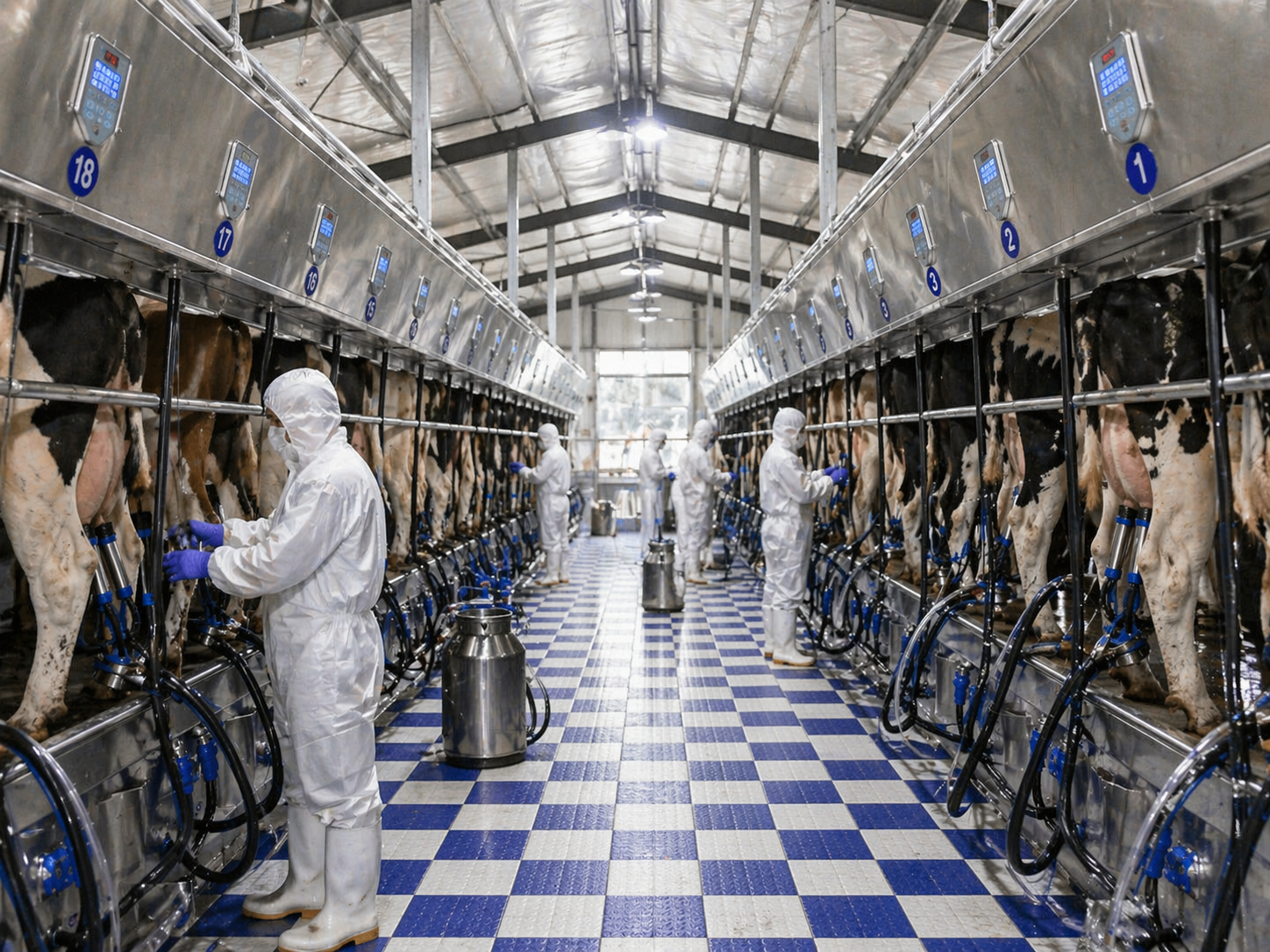
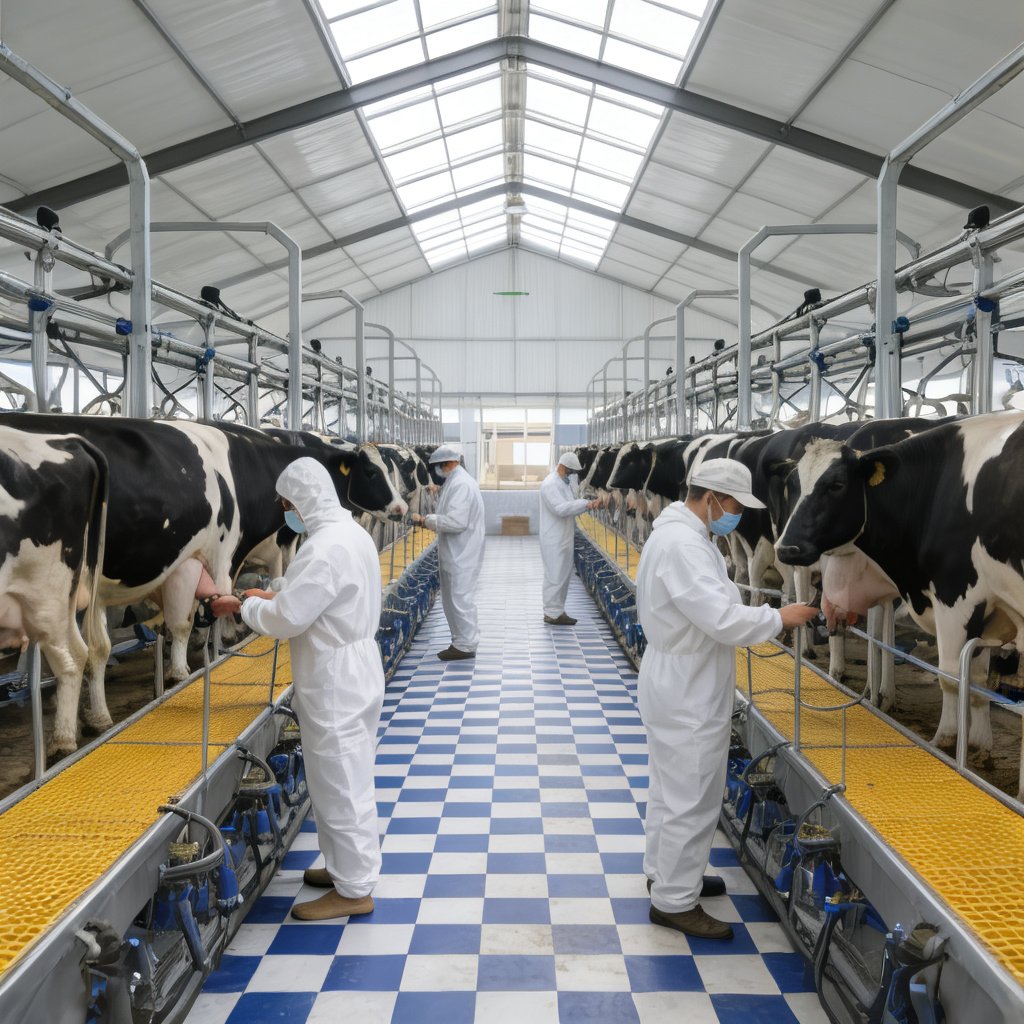
- Parallel parlour: Cows stand perpendicular to the operator pit, with their rear ends facing the milker. This gives direct access to the udder from behind. Cows enter and exit in groups, and rapid exit gates can speed up cow flow. The operator works at a comfortable height, reducing bending.
- Herringbone parlour: Cows stand at an angle (usually 30–45 degrees) to the operator pit, allowing access to the udder from the side. This traditional layout is straightforward to build and manage, with the operator moving along the pit. Side access can be more tiring for the milker over time compared to parallel designs.
- Rotary parlour: Cows walk onto a slow-rotating platform, with the milker stationed in a fixed position. The platform carries cows through the milking cycle. Rotaries can be highly efficient for large herds but require significant capital and a dedicated building layout.
- Tandem parlour: Each cow enters an individual stall, one at a time, and stands parallel to the operator lane. The milker accesses the udder from the side. Tandem parlors offer maximum cow individualization and are often chosen for cow comfort on smaller farms or with high-value genetics.
Parallel vs Herringbone vs Rotary vs Tandem: A Quick Comparison Table
| Feature | Parallel | Herringbone | Rotary | Tandem |
|---|---|---|---|---|
| Cow position relative to operator | Perpendicular (rear access) | Angled (side access) | On rotating platform | Parallel to operator lane (side access) |
| Udder access | Rear, clear view | Side, good view | Varies by stall orientation | Side, ample working space |
| Typical throughput (cows per hour per operator) | High (50–80+) | Moderate to high (40–70) | Very high (80–100+) | Low to moderate (30–50) |
| Space requirement | Moderate footprint | Moderate to large | Large dedicated building | Larger per cow |
| Labor efficiency | Good; single operator can manage many cows | Good; easy to monitor multiple cows | Excellent; fixed operator position reduces fatigue | Lower; one-on-one handling slows throughput |
| Cow comfort | Good if stall dimensions fit breed | Good for most cattle | Generally good, but acclimation needed | Excellent; individual stall tailored to cow |
| Ease of expansion | Modular; can add stalls to a point | Easily extended in length | Difficult; internal circumference fixed | Can add individual stalls |
| Typical herd size fit | 100–1,000+ cows | 50–500+ cows | 300–3,000+ cows | 30–200 cows |
| Cleaning complexity | Spot cleaning easy; back wall needs attention | Squeegee system effective; pit design matters | Platform sanitation automatic; corners require monitoring | Each stall cleaned individually; labor-intensive |
Which Parlor Best Fits Your Herd Size and Milking Routine?
The number of cows you milk and how often you milk them shapes the parlor choice. A parallel parlour excels when you need to move large groups through quickly with minimal labor. For a herd of 200–600 cows milked twice a day, a double‑10 or double‑12 parallel can handle the job without excessive operator strain. Herringbone parlors work well for mid‑sized herds (100–300 cows) and are forgiving if your cow flow is less uniform because cows can be released individually if needed.
If you manage a very large dairy (500 cows or more) and want to maximize throughput per worker, a rotary parlour can be transformative. The constant flow and fixed workstation reduce walking, so one operator can achieve high turns. However, rotary systems demand a substantial upfront investment and may not be practical for seasonal or pasture‑based farms where cows walk long distances to the parlor.
Tandem parlors, while slower, give the milker control over each animal. They are popular in small family dairies, show herds, or farms that need to handle cows individually for health checks and treatments. According to the Dairy Cattle Science textbook (4th Edition), individual stall parlors allow closer observation of each cow but at a higher labor cost per gallon of milk.
For sizes, materials and configuration options, check the parallel milking parlor specifications on our product page.
Other Parlor Options: Swingover, Robotic and More
Swingover parlors
A swingover parlour is a simpler setup often used on smaller dairy farms. Cows are positioned in stalls, and the milking unit swings from one side of the parlour to the other, so one cluster serves cows on opposite sides. The operator swings the unit over between cows, which reduces the number of milking machines needed.
- Operator position: Central work area, often at cow level rather than a deep pit.
- Udder access: Side access or between rear legs, depending on stall design.
- Throughput: Slower per stall, because the operator must swing the cluster manually.
- Best for: Small herds (10–60 cows) or farms with limited budget and space.
Some swingover parlours have a pit; others are flat-floor systems. The design suits farms where labour is not the main constraint, and the focus is on low initial cost and simplicity.
Robotic milking
Robotic milking systems, also called automatic milking systems (AMS), allow cows to be milked without direct human presence. Cows enter a stall voluntarily, sensors detect the udder, and robotic arms attach the teat cups. The system cleans, milks, and releases each cow independently.
- Operator role: Monitoring and management, not routine milking.
- Cow flow: Free, voluntary entry, usually with a smart gate system.
- Labour: Replaces manual milking labour but increases management data requirements.
- Best for: Farms willing to rethink cow routines, often 50–250 cows per robot unit.
Robotic parlours shift labour from milking to oversight. They provide individual cow data and can improve milk frequency, but they require reliable technical support and a barn layout designed for voluntary cow traffic.
Rapid-exit and other variations
Beyond the main types, some farms use variations:
- Rapid-exit herringbone: Adds a front lift gate for faster batch release.
- Polygon or trigon parlours: Multi-sided pit layouts that increase stall count with shorter walking distance.
- Tandem parlours: Cows stand nose-to-tail and enter/exit individually, useful for small groups or special-needs cows.
These variations are built on core layouts and should be evaluated as adaptations of the primary types covered above.
Labor Requirements and Operator Safety: A Practical Look
Operator fatigue and safety are often overlooked until after the first month of milking. In a parallel parlour, the milker stands upright with the udder at chest height, which reduces back strain compared to side‑access layouts. Herringbone pits require the operator to bend slightly sideways to attach units, which can cause more fatigue over a long shift. Rotary parlors reduce walking dramatically—the milker stays in one spot—but the monotony of fixed-position work and the need to stay alert while cows rotate past presents its own ergonomic challenges.
From a safety standpoint, parallel and herringbone parlors place the operator in a pit below cow level, which offers a physical barrier. In a tandem parlor, the operator often works at the same level as the cow, so handling gates and quick exits must be well‑designed to prevent kicks. University Extension resources frequently note that no matter the design, proper training and anti‑fatigue matting are essential for milker well-being.
Cleaning Efficiency and Milk Hygiene: Design Matters
Hygienic milking starts with a clean udder and a clean machine. Parlor layout affects how easily manure and milk residues can be washed away. Parallel parlors often have a sloping back shelf behind the cows; if not designed correctly, this can trap debris. Herringbone pits with a central drain and squeegee system are straightforward to keep clean if the floor slope is adequate.
Rotary platforms include automated washing systems that clean the deck as it rotates, which can improve consistency. However, tight spaces under the platform need regular inspection. Tandem stalls, because each is separate, require manual cleaning of each bed—a time‑consuming process that can easily be skipped during busy milking sessions, risking mastitis pathogens.
In all parlor types, the milk line routing, pulsator placement, and floor drainage determine how easily bacteria are controlled. Industry manuals often stress that cleaning protocols must be written for the specific parlor geometry, not copied from another farm. The NRCS Agricultural Waste Management Field Handbook highlights that parlor wastewater management is a key factor in overall farm hygiene.
Planning for the Future: Expansion and Long-Term Flexibility
Few dairies stay the same size forever. When comparing parlors, ask how easily you can add cows without a full teardown. Herringbone parlors are the simplest to extend—you can often add a few stalls on each side by extending the pit and building. Parallel parlors can also be extended, but the width of the holding area and exit lanes must accommodate the extra cows.
Rotary parlors are the least flexible for expansion. The platform size is fixed at installation, and increasing cow throughput usually means faster rotation speeds or a second platform, which is a major capital project. Tandem parlors can grow stall by stall, but the linear layout may eventually require a longer building.
If you anticipate steady growth over the next decade, a parallel or herringbone design with a modular pit and holding area may give you the most manageable upgrade path. Farms that plan to stay small often choose tandem parlors, valuing the per‑cow attention over peak throughput.
Common Planning Mistakes
- Overbuilding for the current herd: A large parlour with too many stalls wastes time and cleaning effort.
- Underestimating future growth: Rebuilding a pit or changing the parlour type is expensive later.
- Ignoring cow flow: Poor entry and exit design causes delays and stress.
- Selecting the wrong access position: Side-access, rear-access, and herringbone angles affect milker comfort and speed.
- Neglecting ventilation and lighting: Parlours need consistent airflow and good visibility for udder health.
- Treating all types of milking parlour as equal: A parallel design cannot easily be converted to a swingover later without major construction.
Preventing these mistakes starts with a clear farm profile before speaking with equipment suppliers or barn builders.
Final Takeaway: Match the Parlor to Your Farm’s Real Priorities
No single parlor type wins for every dairy. A parallel parlour might be the most efficient for a 400-cow operation with limited labor. A herringbone could be the practical choice for a herd that values simple maintenance and moderate throughput. A rotary could pay off on a 1,500-cow farm looking to break labor bottlenecks. A tandem might be the perfect fit for a 60-cow registered herd where each animal receives individual care.
Before you decide, walk your facility with a measuring tape and a list of daily routines. Think about cow flow from the holding area, operator workflow, wash‑down time, and how the parlor will feel on a cold winter morning. By focusing on the work, not just the equipment, you’ll choose the parlor that helps your farm run smoother for years to come.
Frequently Asked Questions
What is the main advantage of a parallel milking parlour over a herringbone?
A parallel parlour offers rear udder access, allowing the operator to work at a more upright, ergonomic position. It typically achieves higher throughput per operator because cows can exit quickly as a group.
Is a rotary parlour worth the higher investment for a medium-sized herd?
For herds under 300 cows, a rotary parlour rarely pays back the higher capital cost unless labor is extremely scarce. However, dairies with 500+ cows often justify the expense through labor savings and increased milkings per day.
Can I convert a tandem parlour to a parallel layout later?
Conversion is usually impractical because tandem stalls are wider and have different pit and gating requirements. It is more cost-effective to choose the design that fits your long-term plan from the start.
How does parlor type affect cow stress during milking?
Tandem and herringbone designs give cows more individual space and a calmer entry, reducing stress. Parallel parlors can increase cow competition at entry if the crowd gate is too aggressive. Rotary acclimation requires training, but once accustomed, cows often load calmly.
What are the most common mistakes when choosing a milking parlor?
The biggest mistakes are underestimating long-term herd growth, ignoring operator comfort (flooring, pit depth), and failing to account for daily wash-down time. Visiting similar farms with the parlor type you are considering can help avoid these pitfalls.
Which parlor design is easiest to keep clean during milking?
A properly sloped herringbone pit with a center drain is often the simplest for manual cleaning. Rotary platforms with automated washing systems are consistent but hide debris under corners. Parallel back shelves can accumulate manure if not designed with steep slopes.
Do I need a different stall size for Holsteins vs. Jerseys in a parallel parlour?
Yes. Breed size matters. Most manufacturers offer different stall widths and lengths. In a parallel parlour, larger Holsteins need wider stalls to prevent slipping and to ensure comfortable udder positioning for the operator.
Can a swingover parlour be upgraded later?
Physically changing a swingover into a herringbone or parallel system usually requires pit reconstruction and stall changes, so it is not a simple retrofit. Planning ahead is wiser.
Are robotic milking parlours suitable for grazing herds?
Yes, but they require careful cow traffic design. Many grazing farms use robotic systems with a guided or free-cow-flow layout that allows pasture access between voluntary milkings.
How long does it take to milk in a parallel vs. herringbone parlour?
Parallel parlours can have slightly faster cow entry and exit, but total milking time also depends on cow-to-operator ratio and the number of units. Both can handle similar cows per hour when sized correctly.
References
- Penn State Extension guide to Standard Operating Procedure for the Milking Facility
- Penn State Extension guide to Safety Risks in the Milking Parlor Non Biological Exposures
- Penn State Extension guide to Seconds Do Matter in Your Milking Routine
- Penn State Extension guide to Transitioning to a New Robotic Milker