Key Concept and Practical Farm Use
If you milk animals on a small farm, a milking machine can save hours of daily labor and improve milk handling. This article explains what a milking machine is, how it pulls milk safely, and what to know before using one on a small-scale dairy operation. It is written for smallholders, homesteaders, and part-time farmers who want clear, practical information—not a sales pitch.
What Is a Milking Machine?
A milking machine is a mechanical system that extracts milk from dairy animals (cows, goats, sheep, etc.) using vacuum and pulsation. Instead of squeezing the teat by hand, the machine applies a rhythmic vacuum that mimics a calf’s or kid’s suckling action, moving milk from the udder into a clean, closed container.
On small farms, a milking machine is typically a portable or semi-portable unit sized for one to a few animals. It replaces hand milking for people who want to reduce labor, speed up the milking routine, and keep milk cleaner. The basic principle is the same whether you are milking one cow or a small herd, but the equipment is scaled down compared to large commercial dairies.
According to the Dairy Cattle Science textbook (4th Edition), proper milking procedures—whether by hand or machine—are essential to reducing mastitis risk. A milking machine, when used correctly, can support good udder health.
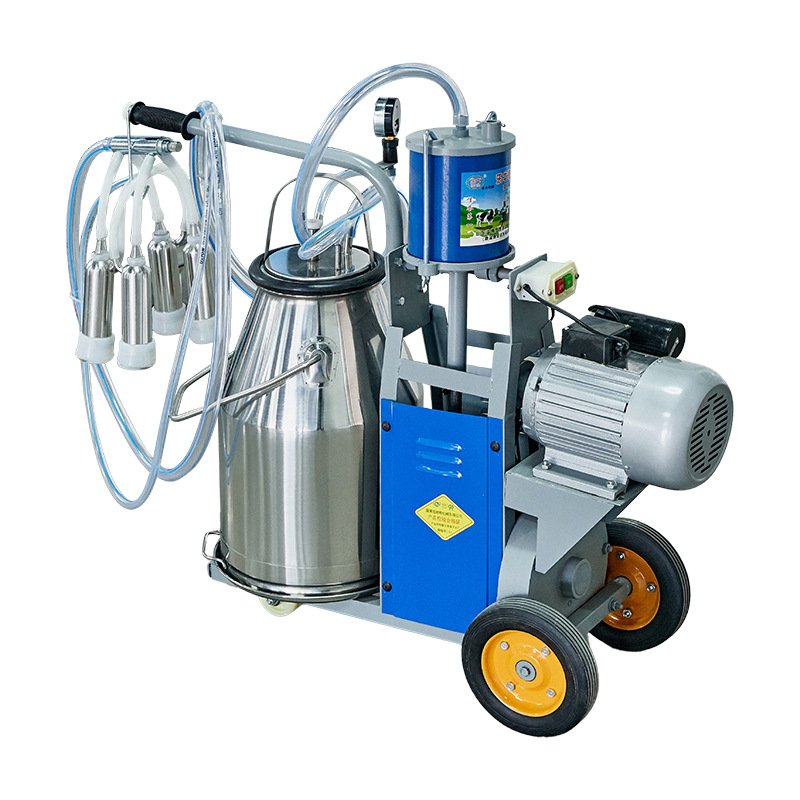
If you are planning a purchase, you can see the full specifications of our vacuum pump portable milking machine.
How Does a Milking Machine Work?
All milking machines work on the same principle: a vacuum draws milk from the teat, and a pulsator interrupts the vacuum to let the teat rest. The two key forces are suction (to remove milk) and massage (to keep blood flowing). Most small-farm units use an electric pump to create vacuum, though some older or portable designs may use a hand-operated pump.
Key Components of a Milking Machine
| Component | Function |
|---|---|
| Vacuum pump | Creates the constant suction needed to move milk |
| Pulsator | Rhythmically alternates vacuum and atmospheric pressure, massaging the teat |
| Teat cups (shell + liner) | Fit around the teat; the liner collapses and releases to extract milk |
| Claw | Collects milk from all four teat cups |
| Milk tube | Carries milk from the claw to the collection container |
| Milk bucket or pipeline | Container that holds the milk; in pipeline systems, it goes directly to a bulk tank |
The Milking Cycle: Pulsation Explained
The pulsator switches between two phases about 50–60 times per minute (depending on the machine):
- Milk phase: The vacuum is applied inside the teat cup liner, the liner opens, and milk flows from the teat. This is similar to the calf drawing milk.
- Rest phase: The vacuum is cut off and atmospheric pressure is let in, causing the liner to collapse around the teat. This massages the teat, prevents congestion, and keeps blood circulating.
This alternating vacuum is what prevents injury. If the teat were under constant vacuum without a rest phase, it would swell and become painful, and milk flow would stop. University Extension guidelines often note that proper pulsation is one of the most important factors for animal comfort and milk letdown.
Types of Milking Machines for Small Farms
Small farms typically choose between a few basic layouts. The right type depends on how many animals you milk, where you milk them, and how you handle milk after harvest.
| Type | Description | Best For | Limitations |
|---|---|---|---|
| Bucket milker | A portable unit where milk collects in a canister or pail next to the animal. Often carried between stalls. | 1–3 cows, small goat herds, milking in different locations | Carrying weight; higher risk of manure contamination in bucket |
| Pipeline system | Teat cups connect to a fixed pipeline that moves milk to a bulk tank or jar in a separate room. | Small herds in a dedicated milking parlor, 3–10+ cows | Higher initial setup; less portable; harder to clean |
| Portable cart milker | Pump and bucket mounted on a cart, moved to the animal. | Milking in multiple paddocks or pens with no fixed parlor | Cart maneuverability; vacuum pump size still limits speed |
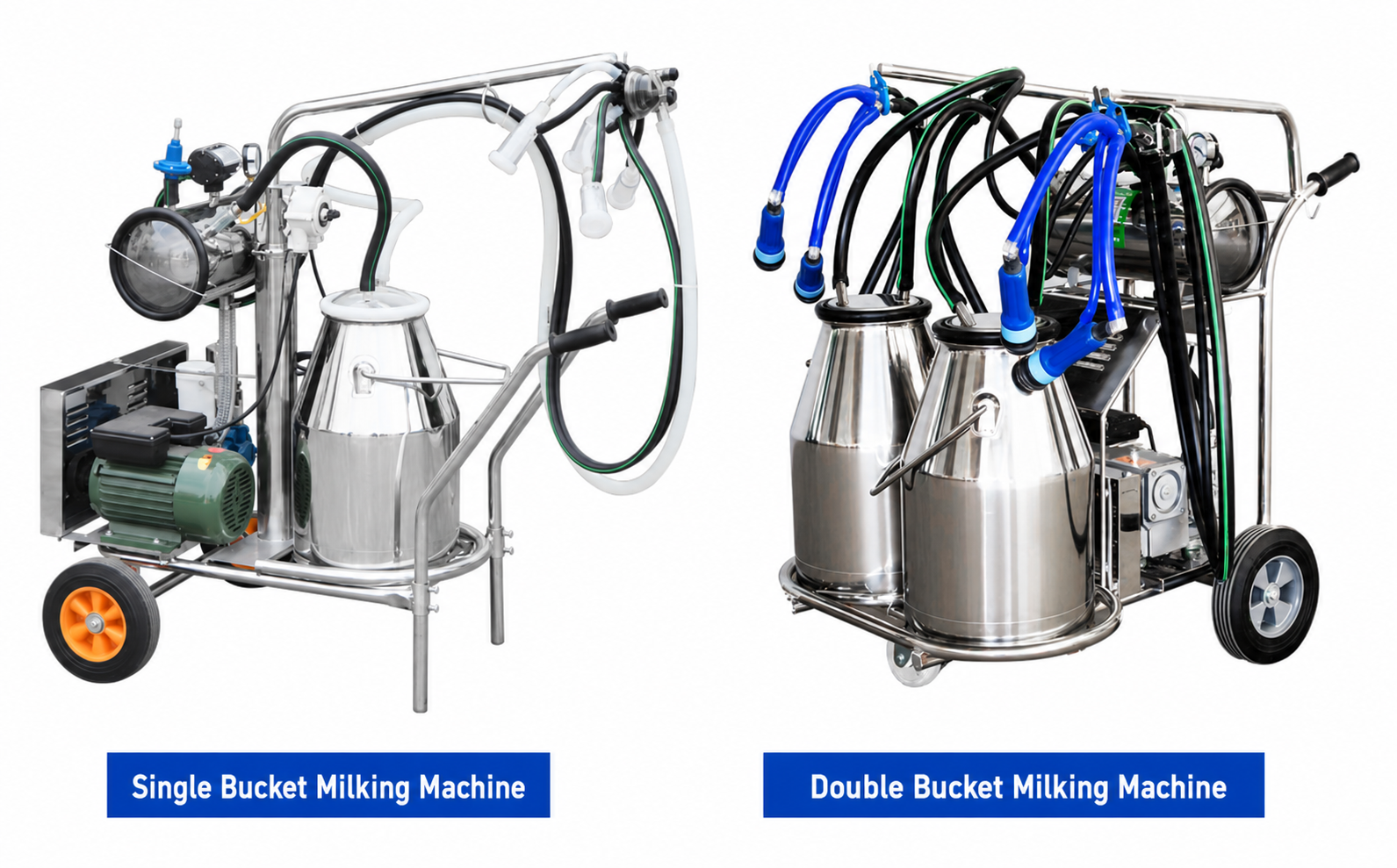
Many small-farm milking machines are essentially bucket milkers designed for one teat cluster at a time (single-bucket or double-bucket). If you are milking only one cow, a simple portable unit is often enough.
Portable vs stationary systems
Not all portable milking machines are built for the same job. The checklist below covers the features that matter most on a real farm.
- Vacuum pump type and power: Electric (110V/220V) or gas-powered? Is the pump strong enough for the number of clusters?
- Number of milking clusters: Single cow machines often have one cluster; two clusters speed up milking for small groups.
- Bucket capacity and number: One or two buckets? For cows, a larger food-grade stainless steel bucket is best.
- Pulsation system: Pneumatic or electronic? Electronic pulsators often offer more stable pulsation rates.
- Weight and portability design: Wheeled cart, carry handle, or lightweight frame? Consider the distance you’ll move it daily.
- Teat cup size and liner compatibility: Suitable for cow teats, goat teats, or interchangeable?
- Ease of disassembly for cleaning: Can all milk-contact parts be taken apart quickly without tools?
- Durability and materials: Stainless steel or high-grade plastic? Farm environments are tough.
- Noise level: Quiet operation reduces animal stress, especially for skittish goats or cows new to machine milking.
According to the Dairy Cattle Science textbook (4th Edition), proper milking system design and liner selection directly influence udder health and milking efficiency. This principle applies as much to portable machines as to large parlors.
Setting Up and Operating a Small-Farm Milking Machine
Good technique matters more than machine size. Even the simplest milking machine needs a consistent routine. Here is a practical step-by-step:
- Pre-milking checks: Make sure vacuum hoses are tight, the pulsator is clean and clicking, and teat cup liners are not cracked. Inspect the milk receiver jar for residue.
- Udder preparation: Wash and dry the udder and teats thoroughly. Strip the first few squirts of milk into a strip cup to check for abnormalities. A clean, dry, and stimulated udder lets milk down faster.
- Attach the unit: Turn on the vacuum and bring the cluster under the udder. Attach teat cups one at a time, starting with the far teats. Avoid letting air rush into the system.
- Monitor milk flow: Watch the milk tube and listen to the pulsator rhythm. If the cluster stays squarely on the udder, the teats should not slip or cup edges fold in. Adjust alignment if needed.
- Remove at the right time: When milk flow slows to a trickle, break the vacuum before pulling cups off. Leaving the cluster on after the udder empties (over-milking) can damage teat tissue. Manually strip any remaining milk if needed.
- Post-dip and clean: Dip each teat with a sanitizing solution. Then immediately rinse and wash all milking equipment with warm water and dairy cleaner to prevent bacterial growth.
Following a standard milking routine—prep, attach, monitor, remove, sanitize—helps maintain udder health and milk quality. USDA guidelines for small dairy herds emphasize consistent pre- and post-milking hygiene as a key disease-prevention measure.
Daily and Weekly Maintenance Checklist
A milking machine has moving parts, rubber liners, and vacuum lines that need regular attention. Neglecting maintenance often leads to poor milking, high somatic cell counts, or equipment failure.
After each milking:
- Rinse all milk-contact surfaces with lukewarm water (not hot, to avoid baked-on milk protein).
- Wash with a dairy cleaning solution and brush; rinse thoroughly.
- Hang tubes and liners to drip dry.
- Wipe down the pulsator and check for dust or moisture.
Weekly:
- Inspect rubber liners for cracks or swelling; replace if needed (usually every 6 months or as per manufacturer recommendation).
- Check vacuum pump oil level if you have an oil-lubricated pump.
- Clean or replace the air filter on the vacuum pump.
- Test pulsator rate and ratio using a pulsation tester or have it checked by a service technician.
- Examine gaskets and seals for leaks.
Many small-farm milking issues—slow milking, liner slip, or abnormal sounds—can be traced to dirty pulsators or worn liners. Preventive maintenance is far easier than troubleshooting during milking.
Daily cleaning and sanitation
Even a well-built portable milking machine can cause problems if used incorrectly. Avoid these common pitfalls:
- Skipping the daily disassembly and cleaning: Quick rinsing is not enough. Bacteria build up fast.
- Using the wrong liner size for the animal: Cow teats and goat teats are different; wrong fit causes slipping or incomplete milking.
- Placing the bucket too low or unstable: Bucket tipping can spill milk and contaminate it.
- Leaving the vacuum pump running too long with no milk flow: Can cause pump overheating or liner damage.
- Ignoring vacuum gauge readings: Too high or too low vacuum pressure harms teats and reduces milk let-down.
- Using a portable machine as a full-time replacement for a larger herd: It is designed for occasional or small-scale use, not continuous high-volume milking.
- Storing the machine uncleaned: Even overnight, milk residues harden and cause cleaning nightmares.
Common Beginner Mistakes with Milking Machines
Even a well-built milking machine for one cow can cause problems if used incorrectly. Small-farm starters often run into these issues:
- Skipping the pre-milking stimulus: If the udder isn’t cleaned and massaged, milk letdown is poor and the machine will milk “dry” teats, increasing discomfort.
- Improper attachment: Twisted liners or cups applied at odd angles cause air leaks and liner slip, which irritates teats and slows milking.
- Over-milking: Leaving the cluster on after the udder empties is a common cause of teat-end damage and mastitis.
- Rough removal: Yanking the cluster without releasing vacuum can tear teat skin.
- Poor cleaning routine: Inadequate washing and drying lets bacteria grow in the milk line, ruining milk quality and possibly infecting the cow.
- Ignoring machine sounds: A hissing sound often means a vacuum leak; irregular clicking from the pulsator means it needs attention. These warning signs are easy to ignore but lead to bigger problems.
- Using the wrong vacuum level: Too high vacuum stresses teats; too low vacuum causes incomplete milking. Most small units operate best around 13–14 inHg (inches of mercury) for cows, but always follow the manufacturer’s setting.
Is a Milking Machine Right for Your Small Farm?
A milking machine is not automatically better for every small farm. It solves specific problems: hand fatigue, slow milking, or difficulty keeping milk clean in an open barn. But it also adds cost, maintenance, and a learning curve. Here is a simple decision framework:
- Number of animals: If you milk more than one cow or a sizable goat herd daily, a machine almost always pays off in time saved.
- Hand strength and time: Hand milking can be tough on wrists and fingers. If physical strain limits how many animals you can keep, a machine may help you scale up.
- Milk hygiene needs: With a closed system, milk is less exposed to hay, dust, or manure. This can make a difference if you sell raw milk or need low somatic cell counts.
- Budget: Small-scale bucket milkers are generally affordable, but they are still an investment. Factor in replacement liners and cleaning supplies. The FAQ below addresses typical cost concerns.
- Power and location: If you milk in a remote pasture without electricity, you need a battery- or generator-compatible unit, or a very small manual pump. Most electric milking machines for one cow require a standard outlet.
For a single cow that is gentle and milked only for household use, a milking machine may not be essential. But for small farms producing for a local market, or where the milker has other chores, a machine often becomes a necessity.
Final Takeaway
A milking machine is a tool, not a magic shortcut. It uses vacuum and pulsation to do what hand milking does—extract milk—but more efficiently and often more hygienically. On a small farm, the right milking machine for one cow or a few animals can reduce daily labor, maintain udder health, and keep milk cleaner, provided you follow a good routine and maintain the equipment.
Start by understanding the basic how-it-works, then compare types, and then focus on technique and cleaning. The difference between a frustrating session and a smooth milking often comes down to a clean machine, a calm animal, and a consistent process.
Frequently Asked Questions
How much does a milking machine cost for one cow?
Cost varies by type and region, but small portable bucket milkers suitable for one cow generally range from a few hundred to over a thousand dollars. While the initial expense is significant, it is often justified by labor savings and better milk quality for small dairy operations.
Can I use the same milking machine for cows and goats?
Many small milking machines come with different teat cup liners and pulsation settings for cows, goats, or sheep. However, not all units are multi-species. If you plan to milk both cows and goats, look for a model that allows liner and vacuum adjustments—or budget for separate clusters.
How is a milking machine installed on a small farm?
Portable bucket milkers require no permanent installation—just a clean surface and an outlet. Pipeline systems need a dedicated room or parlor, proper milk line slope, and often a vacuum pump mounted separately. If you choose a pipeline, have it professionally planned to avoid backflow and cleaning difficulties.
Is a milking machine painful for the cow?
When correctly operated, a milking machine is not painful. The pulsator rest phase prevents constant suction, which mimics natural suckling. Pain signals a problem: vacuum too high, wrong liner size, or over-milking. Regular equipment checks and proper attachment keep the process comfortable.
How often should I replace milking machine liners?
Rubber liners typically need replacement every 6 months (or after about 1,500 individual milkings), but this varies with use and material. Cracked or swollen liners lose their massage effect and can harbor bacteria. Always follow the manufacturer’s recommended schedule.
What vacuum level should I use for a small-farm milking machine?
Most small units for cows operate between 12 and 15 inHg (inches of mercury), with 13-14 inHg typical. Goats and sheep often require slightly lower levels. Refer to the machine manual for the correct setting, and avoid turning it up to “speed up” milking—high vacuum damages teats.
Can I run a milking machine on a generator or battery?
Yes, many portable farm models can run on a generator or deep-cycle battery with an inverter, as long as the power rating matches. This is common for pasture-based or rotational grazing setups. Check the pump’s starting wattage before buying a power source.
What is the biggest beginner mistake with milking machines?
The most common mistake is poor cleaning and maintenance. Dirty liners, leftover milk residue, and neglected pulsators quickly lead to high bacteria counts and mastitis. The machine only works as well as the cleaning routine behind it.
Do I need a special power source for a portable milking machine?
Most portable machines run on standard household electricity (110–120V) or can be gas-powered for remote use. Always check the pump’s voltage requirement and whether an extension cord is safe for wet outdoor conditions.
Can I store my portable milking machine outside?
No. Moisture, dust, and temperature extremes damage seals and pumps. Store in a clean, dry shed or barn, and always sanitize before the next use.
How long does it take to milk one cow with a portable machine?
Typically 6–10 minutes per cow, depending on the vacuum system, pulsation rate, and cow’s milk let-down. Proper udder prep and calm handling are just as important as the machine’s power.