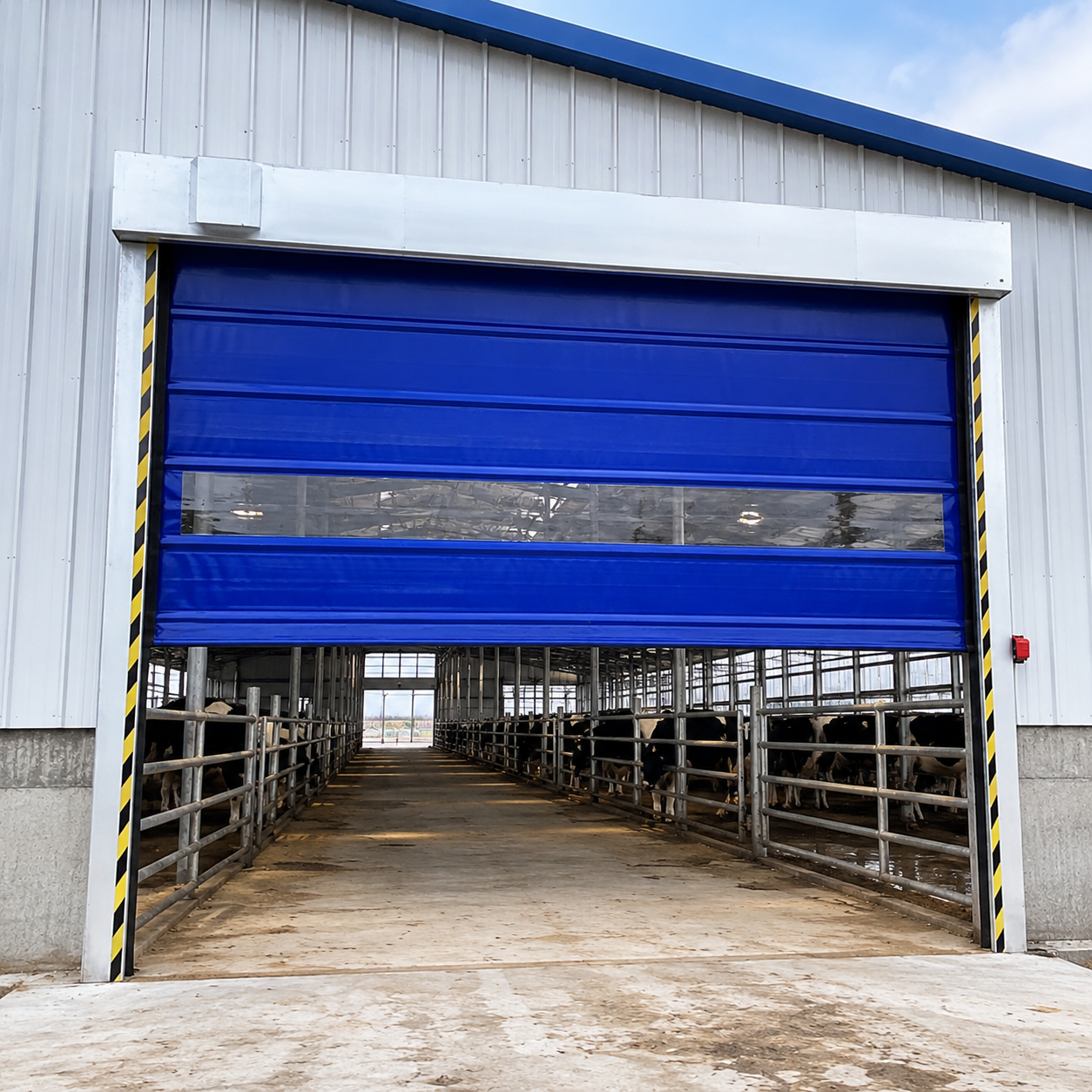
Rolling doors are large overhead doors that coil up into a compact roll above the opening, rather than sliding sideways or swinging out. On livestock and mixed-purpose farms, they are often used for drive-through access, equipment storage, hay barns, and wide building entrances that need to open and close repeatedly.
This guide explains where rolling doors fit on a farm, what to compare before choosing a door, and how to manage daily use, inspection, and safety. It is written for farmers, barn managers, and anyone planning a new barn opening or replacing an old door system.
What Are Rolling Doors in Livestock Barns?
A rolling door consists of interlocking horizontal slats that run up vertical tracks and coil into a barrel assembly above the opening. Unlike sliding doors that move along a wall, rolling doors store overhead and leave the wall space clear for equipment, alleyways, or other uses.
In livestock barns, these doors are typically made of galvanized steel or aluminum, and they may be manually operated with a chain or equipped with a motor for powered operation. Insulated versions are available for climate-controlled areas, while non-insulated models are common for open-sided machinery sheds and hay storage.
According to standard farm building practices, a properly installed rolling door should operate smoothly even after years of exposure to dust, humidity, and temperature extremes common in livestock environments.
Where Rolling Doors Work Best on Farms
Rolling doors are most practical where wide, tall openings are needed and wall space beside the opening is limited. Typical farm applications include:
- Main drive-through bays in machinery sheds and implement storage
- Barn end walls for hay and bedding delivery
- Livestock building openings that require frequent vehicle access
- Portable or temporary structures where floor tracks would be a tripping hazard
- Climate-controlled rooms such as milk houses or veterinary areas, when insulated
- Areas with high wind, where sliding doors might bind or blow off track
Rolling doors can also be used in combination with curtain systems, where the door provides secure closure and the curtain handles daytime ventilation during milder weather.
For sizes, materials and configuration options, check the roll-up barn doors specifications on our product page.
Rolling Doors vs. Sliding Doors vs. Curtains
Farm openings are served by three main types: rolling doors, sliding doors, and fabric or plastic curtain systems. The best choice depends on access patterns, building use, and maintenance tolerance.
| Feature | Rolling Doors | Sliding Doors | Curtains |
|---|---|---|---|
| How it opens | Coils upward | Slides sideways | Rolls up or folds vertically |
| Wall space requirement | Minimal; clears the entire opening | Requires clear wall length to one or both sides | Requires only the width of the rolled fabric at the top |
| Floor track | No floor track | Often has a bottom track that can clog with debris | No floor track |
| Wind resistance | Good when properly installed | May rattle or jump track in high wind | Curtains can billow; wind-rated designs available |
| Insulation and sealing | Can be insulated; seals well | Gaps common at edges | Limited insulation; mainly for natural ventilation |
| Best for | Frequent vehicle access, secure closure, tight sites | Large openings with available wall space, lower cost | Naturally ventilated barns in moderate weather |
When planning a livestock barn, the USDA Natural Resources Conservation Service recommends choosing an opening design that supports both animal comfort and daily workflow, which often means matching door type to ventilation strategy and traffic pattern.
Motorized or Manual Doors
A motorized roll up door is not a universal solution for every opening. It provides the most value where daily usage is high, the door is large or heavy, and quick access directly affects farm productivity. Common livestock farm applications include:
- Main barn or drive-through equipment shed: Frequent tractor, skid steer, or feed wagon entry benefits from hands-free opening.
- Feed mixing or commodity bays: Operators often carry buckets or drive loaders; a motorized door reduces stops and manual lifting.
- Covered cattle alleys or transition areas: Helps control animal flow while allowing quick opening when machinery needs to pass.
- Hay or bedding storage: Large openings used daily for loading and unloading are easier to manage with powered operation.
- Vet or handling area access: Quick, quiet operation reduces stress during animal movement.
According to the Midwest Plan Service’s Agricultural Building and Equipment Handbook, door openings in farm structures should be sized to accommodate equipment and animal movement without crowding, and the door type should match the frequency and nature of traffic. A motorized option often fits when manual operation would slow down critical work.
Where a motorized door makes sense
Choosing the right motorized roll up door for a farm goes beyond looking at dimensions. These practical factors help narrow down options:
- Opening width and height: Must clear the tallest equipment with safety margin. Standard tractor with loader, loaded feed wagon, or skid steer with raised arms should pass without touching.
- Daily cycle frequency: A door opened 30 times a day needs stronger motor and components than one opened twice.
- Power supply and location: Ensure a dedicated circuit is available near the opening; voltage drop over distance can affect motor performance.
- Environment and exposure: Wind, rain, snow, dust, and corrosive gases (from manure or silage) affect slat material and track design. Look for corrosion-resistant finishes and weather seals.
- Safety features: Photo eyes or bottom edge sensors prevent closing on animals, equipment, or people. An auto-reverse mechanism and manual override in case of power loss are essential.
- Speed: Typical farm doors open at 8–12 inches per second. Faster speeds may add cost but reduce heat loss in cold climates.
- Insulation: For heated barns or temperature-sensitive areas, insulated slats help control condensation and energy loss.
- Backup operation: A chain hoist or manual crank override must be included for emergencies or power outages.
Farm operators should also check local building codes and ventilation requirements. In some areas, a motorized roll up door may need to meet wind load ratings or fire separation standards if attached to a dwelling.
Key Factors to Consider Before Selecting Rolling Doors
Choosing the right rolling door involves more than picking a size. The following factors directly affect long-term performance on a farm:
- Opening size and clearance: Measure width and height accurately, and verify headroom for the coil assembly.
- Material and corrosion resistance: Galvanized steel is common; aluminum is lighter and resists corrosion better in humid barns.
- Manual vs. motorized: Manual chain hoists work for doors used a few times a day; motorized operators are better for high-traffic openings.
- Insulation need: Insulated doors help maintain indoor temperature in heated areas such as calf nurseries or milk rooms.
- Durability: Look for reinforced slats, sturdy tracks, and heavy-duty hardware that handle daily bumps from farm equipment.
- Safety features: Include manual overrides, breakaway bottom bars, and photo-eye sensors for powered doors.
- Weather sealing: Brush seals and weatherstripping reduce drafts, bird entry, and snow infiltration.
Common Mistakes in Rolling Door Selection and Use
Even a well-built door can perform poorly if installed or used incorrectly. Avoid these common mistakes:
- Choosing a door too heavy for the building structure; always check header and jamb support.
- Underestimating headroom, leaving insufficient space for the coiled door.
- Ignoring side clearance for tracks, especially near interior walls or feeding lanes.
- Using a manual chain hoist on a doorway that is opened and closed many times daily.
- Failing to install weather seals, leading to drafts and dust entry into feed storage or livestock areas.
- Neglecting to train farm staff on proper operation, especially motorized door controls.
- Not providing a secondary manual release for power-operated doors in case of outage.
Installation Planning: Power, Clearance and Safety
A motorized roll up door on a farm endures dust, moisture, temperature swings, and frequent impacts. A simple daily and seasonal routine prevents failure.
Daily visual checks:
- Look for bent slats, loose bolts, or debris in the bottom track.
- Test photo eye by waving a hand below the closing door; door should reverse immediately.
- Watch and listen for unusual noise, hesitation, or rubbing.
Weekly:
- Clean track grooves and barrel area of dust, cobwebs, and hay chaff.
- Check that manual chain or crank moves freely.
- Inspect cables or lifting straps for fraying.
Monthly:
- Lubricate rollers, hinges, and bearings with a dry lubricant appropriate for farm environments (avoid sticky grease that traps dust).
- Test the manual override operation fully.
- Verify that safety edges or air-wave sensors are functioning.
Seasonally:
- Before winter, check weather seals and adjust limit switches if cold causes curtain shrinkage.
- In spring, inspect for rust and touch up scratches.
- After storms, confirm tracks are plumb and level.
All operators should be trained on the location of the manual release and emergency stop. According to safety best practices published by agricultural safety programs (such as those from land-grant universities), all powered farm equipment—including doors—must have clearly labeled emergency shut-offs accessible from both sides of the opening.
Daily Inspection and Basic Maintenance
Rolling doors need less attention than sliding doors, but a quick daily or weekly check can prevent most breakdowns. The following maintenance routine is based on typical manufacturer guidance and farm service records:
- Visual check: Look for bent slats, loose bolts, or debris in the tracks.
- Track cleanliness: Keep vertical tracks free of manure, bedding, and ice.
- Coil area: Check that the door rolls evenly and does not pull to one side.
- Lubrication: Apply a farm-grade lubricant to hinges and rollers as specified in the door manual.
- Balance test (manual doors): The door should stay in place when opened halfway; if it drops, spring tension needs adjustment.
- Safety edge check (motorized doors): Test the automatic reverse or breakaway function monthly.
- Weather seals: Replace worn or torn seals before extreme weather seasons.
According to the Farm Buildings: Design and Construction handbook, regular inspection and lubrication are the cheapest ways to extend a rolling door’s service life in agricultural use.
Safety Considerations for Rolling Doors
Rolling doors are heavy and can cause serious injury if not respected. Focus on these safety points:
- Keep clear of the opening: Never walk or drive under a moving door; wait until it is fully raised.
- Pinch points: Train all farm workers about the danger zones where slats meet track.
- Motorized door controls: Mount control switches out of reach of animals and away from busy traffic paths. Use lockable disconnect switches.
- Manual chain hoist: Avoid pulling at an angle; ensure the chain is not a hanging loop hazard.
- Emergency stop: For powered doors, confirm that the stop button is reachable and works instantly.
- Child safety: Restrict access to door controls and never allow children to operate the door.
Land-grant university extension services consistently emphasize that farm machinery and motorized building components require the same safety discipline as tractors and PTO shafts.
When Rolling Doors Are Not the Right Choice
Despite their advantages, rolling doors are not the best fit for every farm opening. Consider other options when:
- The opening is extremely wide without adequate headroom for the coil.
- The budget is tight and a simple sliding door will meet access needs with low traffic.
- The building is used mainly for natural ventilation, where a curtain system provides better airflow control.
- Animals will frequently brush against the bottom of the door; roll-up fabric curtains may be more forgiving.
- Frequent power outages make a powered door risky without a reliable backup generator and manual override.
In these cases, consult a barn designer or extension resource to evaluate whether a sliding, curtain, or hinged door system would better match the farm’s daily routine and building constraints.
Final Takeaway
Rolling doors offer space-saving, secure access for livestock barns, machinery sheds, and feed storage areas. They are especially useful where wall space is limited and vehicle clearance matters. However, a rolling door must be correctly sized, properly maintained, and operated with clear safety rules. Comparing rolling doors against other opening systems—and checking the mounting structure, insulation need, and day-to-day usage—will help you decide whether a rolling door is the right long-term solution for your building.
Frequently Asked Questions
What is the difference between a rolling door and a roll-up door on a farm?
In farm language, the terms are often used interchangeably. Technically, a rolling door has slats that coil around a barrel, while a roll-up door can refer to a single-panel door that rolls up, but most agricultural buildings use the slatted rolling type.
Can rolling doors be installed on an existing pole barn?
Yes, if the header is strong enough to carry the weight of the door and the door assembly. Many older pole barns require an engineered header upgrade before installation.
How much does a farm rolling door cost?
Cost depends on size, material, insulation, and motorization. For planning purposes, even a basic manual door for a typical 12-foot by 12-foot opening represents a significant building investment, so get multiple quotes and compare specs.
What size rolling door is best for a hay barn?
Width should comfortably clear your largest bale wagon or truck, typically 14 to 16 feet. Height must clear the highest load when raised; 14 feet is a common minimum for large hay equipment.
Do rolling doors need electricity?
Manual chain-operated doors do not. Motorized doors do. In remote locations, solar-powered operators are available, but they require correct sizing and battery storage.
How do I keep birds and rodents out of a rolling door opening?
Install brush seals along the sides and a rubber bulb seal at the bottom. Keep the area around the door clear of spilled feed, and inspect seals regularly for gaps.
Is a rolling door safe around cattle?
Generally yes, but animals should not be near a moving door. Use solid paneling if cattle will crowd the opening, and always secure the door fully open or fully closed, never partly open where an animal could become trapped.
How long does a farm rolling door last?
With proper maintenance and lubrication, a well-made galvanized rolling door can serve 15 to 25 years in most agricultural environments. Coastal or high-corrosion areas may shorten this lifespan.
What size motorized roll up door do I need for a tractor with a loader?
Measure the maximum height of the tractor with the loader fully raised and add at least 12–18 inches of clearance. For width, measure the widest implement or vehicle (including mirrors or bale spear extensions) and add 2–3 feet on each side for safe navigation. Never size exactly to the machine dimensions.
How do I operate a motorized roll up door if the power goes out?
All motorized doors should have a manual override, typically a chain hoist or crank. Ensure every operator knows where it is and how to engage it. Practice using it quarterly so that during an emergency, no one is forced to force the door open and damage components.
Will a standard motorized roll up door work in freezing temperatures?
Most farm-duty doors operate in cold weather if kept free of ice buildup. However, in extreme cold, grease can stiffen and metal contracts. Some doors require low-temperature lubricants and heated bottom seals. Insulated slats help reduce frost formation. Ask about cold-weather kits if your region sees prolonged sub-zero temperatures.