What Is a Total Mixed Ration (TMR)?
A total mixed ration is a precisely blended feed mixture that combines all dietary components into a single, uniform feed. According to the textbook Large Dairy Herd Management (3rd edition), TMR feeding is designed to deliver a consistent nutrient profile in every mouthful, which helps maintain rumen pH, fiber digestion, and energy intake. The key idea is that cows cannot pick out the tasty grain and leave the forage behind, so each bite contains balanced energy, protein, and effective fiber.
In practice, a TMR can include:
- Chopped or long-stem forages (corn silage, haylage, straw)
- Ground or rolled grains (corn, barley, wheat)
- Protein meals (soybean meal, canola meal)
- Byproducts (distillers grains, beet pulp, whole cottonseed)
- Minerals and vitamins
- Liquid supplements (molasses, fats)
The goal is not just to mix ingredients, but to create a complete meal that supports milk production, growth, or maintenance without the digestive disruptions common with slug feeding of concentrates.
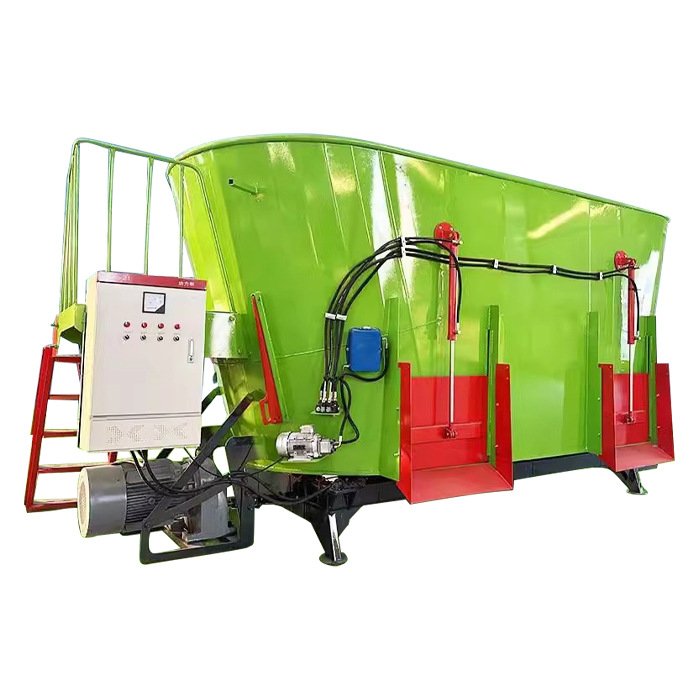
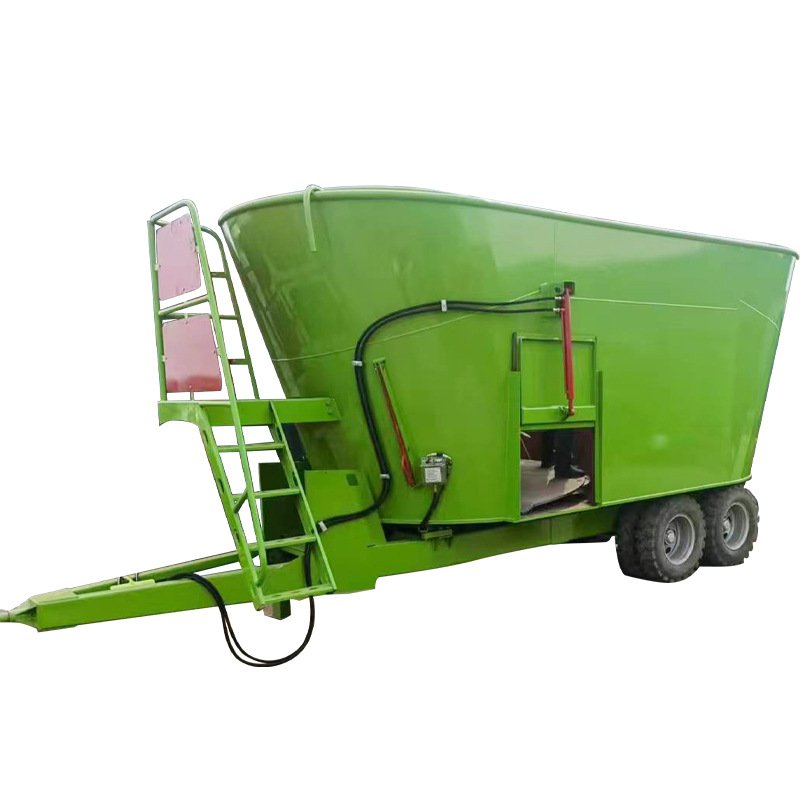
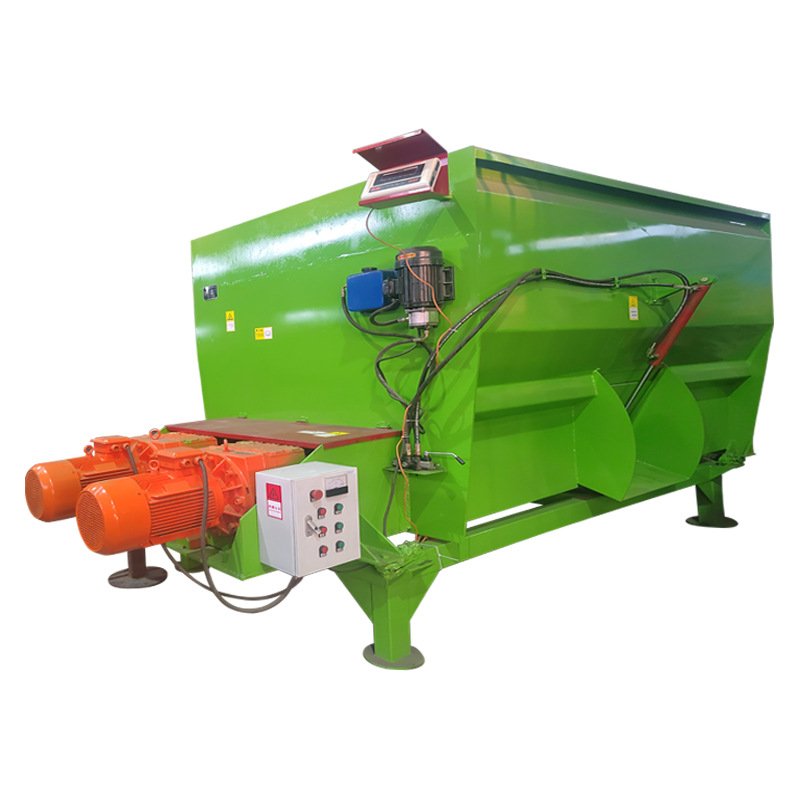
We build this equipment to order; see the full specifications of our vertical TMR mixer for standard sizes and custom options.
Why Do Farms Switch to a Total Mixed Ration?
The benefits of a total mixed ration are well documented for dairy cattle, particularly in herds where high milk production demands precise nutrition. University extension programs frequently cite these advantages:
- Reduced sorting: Cows cannot easily separate grain from forage, so rumen fermentation stays more stable.
- Consistent intake: Each bite offers similar nutrients, which helps avoid feed refusal and metabolic disorders.
- Rumen health: The continuous supply of effective fiber buffers the rumen and lowers the risk of subacute ruminal acidosis (SARA).
- Flexible ingredient use: A TMR can incorporate a wide variety of byproducts and local feeds, often reducing feed cost per unit of dry matter intake.
- Labor efficiency: One-time mixing and delivery can be faster than feeding grain and forage separately multiple times a day.
However, these benefits come with the need for careful ingredient monitoring, mixer maintenance, and consistent feed analysis. A TMR is not a turnkey solution—it is a management system.
Total Mixed Ration vs. Component Feeding
To decide whether a TMR fits your farm, compare it with traditional component feeding, where concentrates and forages are offered separately. The table below highlights the main differences.
| Factor | Total Mixed Ration (TMR) | Component Feeding |
|---|---|---|
| Feed presentation | All ingredients blended into one mix | Forages and concentrates fed separately |
| Risk of sorting | Very low when moisture and particle size are correct | High; cows often eat grain first, then forage |
| Rumen pH stability | Better buffering, fewer pH drops | Possible acid swings, especially with large grain meals |
| Labor and equipment | Requires mixer wagon, scale, tractor; labor for mixing and delivery | May use simpler feeders but often needs more individual feeding events |
| Ingredient handling | Can incorporate wet byproducts, long hay; needs accurate weighing | Grain and hay can be fed as-is; weighing less critical per feeding |
| Cost structure | Higher initial equipment investment; potential ingredient savings over time | Lower equipment cost, but possibly higher feed waste or less intake control |
| Best suited for | Medium to large dairy herds, feedlot cattle, herds with high genetic merit | Small herds, grazing systems, farms with minimal mechanization |
Key Components of a Practical TMR System
Adopting a total mixed ration is more than buying a mixer. A farm needs a system that includes:
- Feed analysis: Forages must be tested for moisture, protein, fiber, and NDF digestibility regularly—at least monthly. Without accurate nutrient data, the ration on paper may not match what cows eat.
- Accurate scales: Every ingredient must be weighed, not guessed. Load cells on the mixer or a separate platform scale are essential.
- Proper mixer type and size: Vertical auger, horizontal paddle, and reel mixers have different mixing actions and suitability for various ingredients. The mixer capacity must match herd size, allowing for future growth.
- Mixing order and time: The sequence of adding ingredients (usually long forage first, then dry grains, wet feeds, and liquids) and the mixing duration greatly affect consistency and particle size.
- Consistent feed delivery: The TMR should be available to cows at the same times each day, with enough bunk space for all animals to eat simultaneously.
- Refusal management: Aim for 2–5% feed refusal to ensure cows had enough, but not so much that feed spoils. Refusals should be weighed and removed daily before fresh feed is offered.
Moisture content and why it matters
A TMR calculator is only one part of consistent feeding. Daily management practices that support accurate execution include:
- Weigh‑backs. Record the weight of feed left in the bunk each day and feed back this number. Without it, the calculator has no real‑time intake data.
- Ingredient inventory check. Before starting, confirm that the same cut of silage or grain is still available. A last‑minute substitution can throw off the recipe.
- Load‑order discipline. Follow the load order that the calculator generates. Some rations require dry grains first, then wet forages, to optimise mixing.
- Mixing time. Over‑mixing degrades physical fibre; under‑mixing leaves chunks. Stick to the recommended time for your mixer.
- Batch documentation. Print the load sheet every day, even if you use software. Having a paper record in the feed room makes troubleshooting simple when something goes wrong.
Using a Ration Calculator
Why calculate the mix
Putting a total mixed ration calculator to work requires a simple, repeatable farm routine. Here is a typical daily process for a pen of lactating dairy cows:
- Update ingredient moistures. Record dry matter percentages from the latest lab analysis or on‑farm quick test. Silage and high‑moisture feeds change most.
- Enter the pen’s dry‑matter targets. These come from the nutritionist’s balanced ration. The calculator converts each target to an as‑fed weight.
- Set batch size. Decide how many head will eat from this batch and the target as‑fed pounds per head. The calculator scales everything accordingly.
- Generate the load sheet. The output is a list of ingredient names and as‑fed weights or bucket‑counts that the mixer operator can follow.
- Record weight‑backs. After feeding, enter the leftover feed weight. The calculator can adjust tomorrow’s batch to avoid over‑ or under‑feeding.
- Spot‑check mixing time and moisture. If the ration looks too dry or too wet, verify the moisture inputs. The ideal moisture content for total mixed ration TMR dairy cows typically falls between 40‑50% depending on the ingredient profile.
Manual, spreadsheet or software
Choosing a total mixed ration calculator is not about flashy features; it is about whether the tool will be used correctly every day. Use this checklist to compare options:
- Does it handle moisture corrections automatically?
- Can it scale batches up or down for different pen sizes?
- Does it show as‑fed weights in the units your mixer uses (pounds, kilograms)?
- Can it account for multiple load orders (first‑cut, second‑cut, etc.)?
- Is weight‑back recording simple enough that the feeder will actually use it?
- Does it flag ingredients when inventory runs low?
- For spreadsheets, are the formulas locked to prevent accidental changes?
- For software, is it compatible with your existing feeding management system?
The best calculator is the one your feed team trusts and updates consistently.
Common calculation mistakes
Total mixed rations that are too dry encourage sorting and reduce palatability. Rations that are too wet can feel heavy, heat up, or limit dry matter intake. For lactating dairy cows, an ideal moisture content for total mixed ration TMR dairy cows is generally 40‑50%. This range helps particles stick to each other, discourages sorting, and keeps the mix cool enough to stay fresh for several hours.
To keep moisture in this range:
- Test silage and wet commodities weekly with a Koster tester or microwave.
- Enter the correct dry matters into your TMR calculator each time you formulate a batch.
- Watch cow behaviour at the bunk. Piles of sorted forage or long stems suggest the ration is too dry.
Daily Management Checklist for a TMR-Fed Herd
Consistency drives TMR success. Use this checklist as a daily guide:
- ✔ Check all ingredient inventories and note any visual changes in quality.
- ✔ Weigh each ingredient as loaded; record actual weights against the formulated ration.
- ✔ Add ingredients in the correct order and mix for the standard time.
- ✔ Check the TMR visually and with a Penn State Particle Separator weekly to ensure proper particle length.
- ✔ Deliver feed within 30 minutes of mixing to avoid heating or spoilage.
- ✔ Push up feed several times a day to encourage intake and reduce sorting.
- ✔ Record and weigh refusals from each pen before feeding.
- ✔ Inspect mixer knives, augers, and scales weekly for wear or calibration drift.
- ✔ Monitor cow behavior: cud chewing, manure consistency, and bunk attendance after feeding.
When to recalculate the formula
- University of Minnesota Extension guide to Feeding Total Mixed Rations
- Penn State Extension guide to Total Mixed Rations for Dairy Cows
- Penn State Extension guide to TMR Management Ensuring Formulated Rations Make It to the Bunk
- Penn State Extension guide to Penn State Particle Separator
Common Mistakes When Starting with a Total Mixed Ration
Even farms with good intentions can hit hurdles. Avoid these frequent errors:
- Ignoring moisture changes: Silage dry matter can shift by 3–5% in a week. Not adjusting wet ingredient weights leads to over- or under-feeding nutrients.
- Overmixing: Mixing too long pulverizes fiber, reducing effective NDF and increasing risk of ruminal acidosis. Aim for 3–6 minutes after the last ingredient, depending on mixer type, and confirm with particle separation.
- Inconsistent feeding times: Cows thrive on routine. Feeding an hour late can cause slug feeding when cows finally access feed.
- Too little bunk space: Dominant cows push out timid ones if bunk space is tight. Provide at least 18–24 inches per mature Holstein cow.
- Poor feed hygiene: Moldy silage or heated wet byproducts in the TMR can reduce intake and cause mycotoxin issues. Clean feed bunks and remove refusals daily.
- Skimping on forage testing: A forage test every 6 months is not enough when quality changes with cutting, ensiling, and feed-out. Monthly testing is a minimum for a stable TMR.
When a Total Mixed Ration Might Not Be the Best Fit
A TMR is not universal. It may be less practical or economically justified in these situations:
- Very small herds (under 20 cows): The equipment cost, even a used mixer, may outweigh benefits. A simpler feeding program with hand-mixing or grazing may be more viable.
- Pasture-based systems: If cows graze intensively, a TMR is often supplementary, not the sole feed. Feeding a TMR in the parlor or on a feed pad becomes a different management challenge.
- Farms without reliable electricity or scale access: Mixers need power for scales and often PTO drives. If infrastructure is weak, TMR adoption can lead to inconsistent mixes.
- Limited labor or skill: TMR management requires training and attention to detail. If the feeder is not weighing correctly or ignores mixing order, the ration falls apart.
- High-risk transition cows: Fresh cows may need specialized diets separate from the lactating herd TMR. A one-group TMR is rarely adequate for transition management without additional grain supplementation.
In these cases, a well-managed component feeding program or a partial TMR (where forage and concentrate are still offered separately but with better control) can yield good results without the full capital outlay.
Final Takeaway
A total mixed ration is a valuable feeding strategy for dairy and beef operations seeking consistent intake, rumen health, and flexible ingredient use. Success hinges on accurate forage testing, reliable weighing, a correctly sized mixer, and disciplined daily management. The switch to a TMR should be driven by a clear understanding of your herd’s nutritional needs, available labor, and infrastructure—not by equipment features alone. Even the best mixer cannot compensate for poor feed quality or sloppy feeding routines. If your farm can commit to the necessary precision and consistency, a TMR can help unlock higher production and better cow health.
Frequently Asked Questions
How much does a TMR mixer cost for a small dairy farm?
Mixer costs vary widely by size, type, and condition (new vs. used). For a small herd (30–50 cows), a used single-auger vertical mixer might cost $5,000–$15,000, while a new one could exceed $25,000. Operational costs include tractor fuel, maintenance, and scale calibration, so budget for those recurring expenses as well.
Do I need a TMR wagon or can I mix by hand?
For more than a few cows, hand mixing a true TMR is impractical because it’s hard to achieve uniform distribution of minerals and small ingredients. Small-scale farms sometimes use a grinder-mixer or a stationary horizontal mixer and then feed the blend, but a TMR wagon provides the best particle size control and delivery efficiency. Hand mixing often results in sorting and inconsistent intake.
What is the ideal moisture content for a TMR?
A target of 45–50% moisture is common for dairy TMRs. This reduces sorting, improves palatability, and keeps ingredients together. Very dry TMR (55%) can heat quickly and reduce dry matter intake. Moisture should be managed by balancing wet ingredients (silage, wet byproducts) with dry feeds.
Can I feed a TMR to heifers and dry cows?
Yes, but the formulation will differ. Growing heifers need limited energy to avoid fattening, while dry cows require a lower-energy, high-fiber diet to control body condition. Many farms use a separate mixer or thoroughly clean the mixer between batches to prevent accidental grain carryover to dry cow rations.
How often should I check TMR particle size?
Use a Penn State Particle Separator at least once a week, and more often if you change forages or see sorting at the bunk. A common dairy TMR target is 2–8% on the top sieve (>19 mm), 30–50% on the middle (8–19 mm), 30–50% on the bottom sieve (>1.18 mm), and no more than 20% in the pan. Variation from this can signal overmixing or underprocessing.
What’s the biggest safety risk when mixing a TMR?
The most serious risks involve entanglement in PTO shafts, auger contact, or being crushed by moving parts. Always shut off the tractor and mixer, engage the parking brake, and wait for all parts to stop before inspecting, cleaning, or repairing. Also, be careful with long-stem hay that can pull an operator into the mixer if not handled properly.
How do I transition cows from component feeding to a TMR?
Introduce the TMR gradually over 7–10 days. Start by replacing one grain feeding with the TMR, then two, until all concentrate and forage are combined. Monitor intake, manure consistency, and milk production closely. A sudden switch can cause a production drop or digestive upsets. Grouping cows by production level helps tailor the transition and ration.
Can I use a TMR on a beef feedlot?
Absolutely. Feedlots commonly use TMRs to blend grains, silage, and byproducts. The principles are similar, though beef diets often include more grain and less emphasis on long particle length. The consistency of a TMR helps keep cattle on feed and reduces digestive disorders in high-concentrate rations.
What if my silage moisture changes every day?
Enter the current moisture into the calculator before printing each day’s load sheet. Even a 2% shift in dry matter can change the as‑fed weight of silage by several kilograms per cow. Automatic moisture‑sensing equipment on mixers can feed this data directly into some software calculators.
How many TMR groups do I need?
That depends on your herd structure. Most dairies run at least two lactating groups (fresh/high and late‑lactation) plus a dry‑cow group. A good calculator makes managing multiple rations simple by saving each pen’s recipe separately.